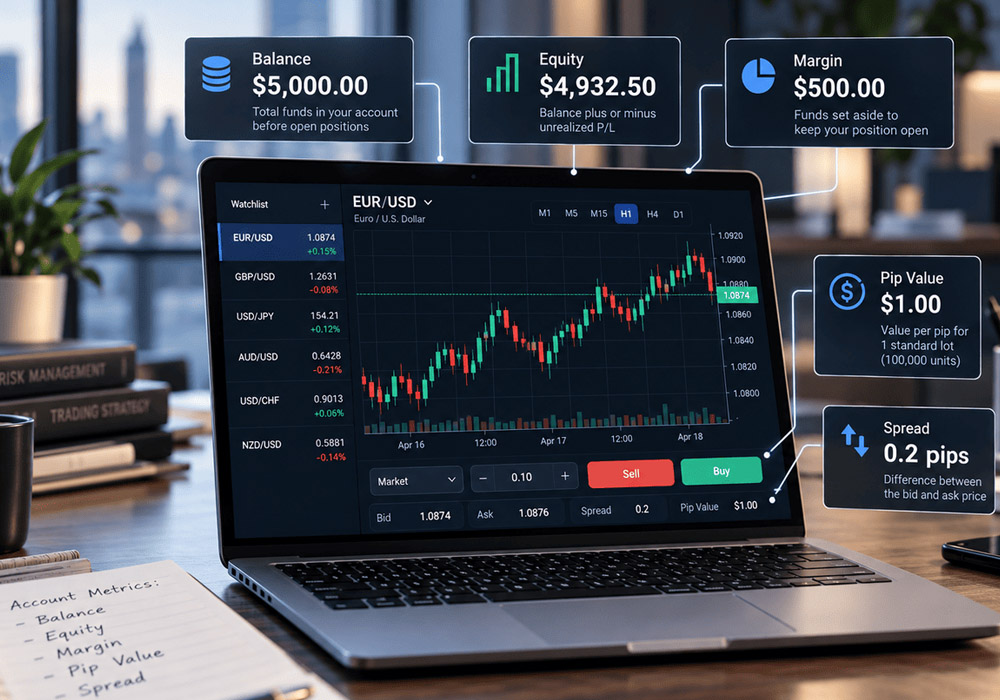
Learn how balance, margin, pip value, spreads and account credit combine to shape your real forex exposure before you place a trade.
A forex trading account can put a surprising number of numbers in front of you.
There is your balance, position size, margin requirement, spread, pip value and available margin. If a promotion is involved, there may be trading credit on top of that.
The difficulty is that these figures do not measure the same thing.
A $500 balance does not mean you are risking $500 on every trade. A $200 margin requirement does not mean $200 is the most you can lose. And a small spread is only useful when you know what that spread costs at the position size you are trading.
Before placing a first forex trade, these are seven numbers worth understanding.
Key Takeaways
- Your account balance tells you how much money is in the account, not how much market exposure you have.
- Position size determines how strongly a currency movement affects your trade.
- Margin tells you how much capital is required to support a position, not its maximum possible loss.
- Pip value turns a change in the exchange rate into a dollar gain or loss.
- Spreads should be considered alongside position size and trading frequency.
- Equity and available margin change as open positions gain or lose value.
- Promotional credit may increase trading capacity without being equivalent to withdrawable cash.
1. Account Balance: What You Have Put Into the Account
The easiest number to understand is usually the account balance.
If you deposit $500 and have not yet traded, your balance is $500. Once trades are closed, realized gains and losses are reflected in that figure.
Where beginners can run into trouble is treating the balance as a guide to how large their positions should be.
It is not.
Someone starting with $100, for example, could technically approach the account in several different ways. Whether $100 is enough to start forex trading depends on factors such as the minimum position available, margin requirements, trading costs and how much of that balance would be exposed on each trade.
The same applies to a $500 or $5,000 account.
Starting capital is useful information. On its own, however, it tells you very little about the amount of risk being taken.
2. Position Size: How Much Currency You Are Exposed To
Position size is where the numbers become more meaningful.
Forex positions are often described in units or lots. A standard lot commonly represents 100,000 units of the base currency, while smaller position sizes can represent fractions of that amount.
Consider two traders who both have $1,000 accounts.
One opens a position representing $5,000 of currency exposure. The other opens one representing $20,000.
Their balances are identical, but the second trader has four times the market exposure.
That means the same movement in the currency pair can have a much larger financial effect on the second account.
This is why comparing account balances without position sizes can be misleading. The amount deposited tells you the size of the account. Position size tells you how much of the market that account is trying to control.
3. Margin Requirement: What It Takes to Open the Position
Margin is the amount an account must have available to support a leveraged position.
Suppose you want to open a $10,000 position and the applicable margin requirement is 2%.
The calculation is straightforward:
$10,000 × 2% = $200
You would need $200 of margin to support that position.
But $200 is not the value of the trade, and it should not be interpreted as the most the trade could lose.
The position still represents $10,000 of market exposure.
For US retail forex, current NFA rules generally set minimum security deposits at 2% of notional value for transactions involving specified major currencies and 5% for other currency transactions. Requirements differ between markets and regulatory jurisdictions, so traders should check the rules that apply to their account.
The important distinction is between capital required to open a position and the financial exposure created by that position.
They are not interchangeable numbers.
4. Pip Value: What a Market Movement Means in Money
Knowing that EUR/USD moved by 10 pips is useful only if you also know what those 10 pips mean for your position.
That is where pip value comes in.
For many currency pairs, a pip is a movement in the fourth decimal place. EUR/USD moving from 1.1700 to 1.1701 is a one-pip move.
The dollar effect depends on position size.
For a EUR/USD position of 10,000 euros, for example, a one-pip movement is approximately $1. A 20-pip movement would therefore represent roughly $20, before accounting for trading costs.
With a 1,000-euro position, the approximate pip value would instead be $0.10.
Same currency pair. Same market movement. Very different financial result.
This makes pip value one of the more useful numbers to calculate before placing a trade rather than after the market has already moved.
5. Spread: What It Costs to Get Into the Trade
A forex quote normally contains a bid price and an ask price.
The difference between them is the spread.
Suppose EUR/USD is quoted at:
Bid: 1.1700
Ask: 1.1702
The spread is two pips.
A two-pip spread might sound small, but its financial effect depends on the value of each pip. If the position has a pip value of approximately $1, that two-pip difference represents roughly $2.
Increase the position size and the dollar cost increases with it.
Trading frequency matters too. A trader who opens two positions in a month experiences transaction costs very differently from someone opening and closing positions repeatedly throughout the day.
Spreads can also change with market conditions rather than remaining fixed at the smallest figure shown in an advertisement.
That makes the headline spread useful, but incomplete. You also need the position size, pip value and likely trading frequency before you can judge what it means for your account.
6. Equity and Available Margin: What Changes While the Trade Is Open
Your balance is not always the most important number once a trade is running.
Suppose an account has a $1,000 balance and an open position currently showing a $100 unrealized loss.
The balance may still show $1,000 because the trade has not been closed. Account equity, however, would reflect the open loss and would be approximately $900.
If the position improves and instead shows a $100 unrealized gain, equity would rise to approximately $1,100.
Available margin, sometimes called free margin depending on the platform, is another figure to watch. It generally represents the portion of equity not currently being used to support open positions.
As losses reduce equity, the amount available to support additional market movement can shrink as well.
That is why traders should understand what happens as equity approaches the account’s margin requirements. Depending on the provider’s rules, insufficient margin can eventually lead to positions being reduced or closed.
The account balance might barely move during all of this.
The other numbers can.
7. Promotional Credit: Why the Total Shown May Not All Mean the Same Thing
There is one more figure that can appear in some forex accounts: promotional trading credit.
This requires a separate distinction because account credit is not necessarily the same as deposited cash.
For example, a forex no-deposit bonus may provide eligible customers with trading credit without requiring an initial deposit. Other promotions might add credit only after an account has been funded.
The headline number tells you how much promotional credit is offered. It does not tell you what that credit can be used for.
Before treating promotional credit as part of your available capital, check the conditions.
Can the credit itself be withdrawn? Can it be used to support margin? What happens to it when money is withdrawn from the account? Are profits generated while using the credit subject to separate conditions?
The answers can vary between promotions.
That is why deposited funds, promotional credit and withdrawable funds should not automatically be treated as three names for the same number.
They may represent quite different things.
Put the Numbers Together Before You Trade
None of these seven figures tells the whole story by itself.
A $500 account might involve relatively modest exposure or a much larger leveraged position. A 2% margin requirement might make a trade possible with relatively little capital, but the position’s full market exposure remains relevant. A one-pip spread could cost very little on one position and considerably more on another.
The useful step is to connect the numbers.
Before placing a trade, know your account balance, position size, required margin, approximate pip value and spread. Once the position is open, understand how changes in the market affect equity and available margin.
And if promotional credit appears in the account, find out what that number actually represents before counting it as your own money.
Forex platforms display plenty of figures. Understanding which ones measure cost, exposure and available capital makes those numbers considerably more useful.