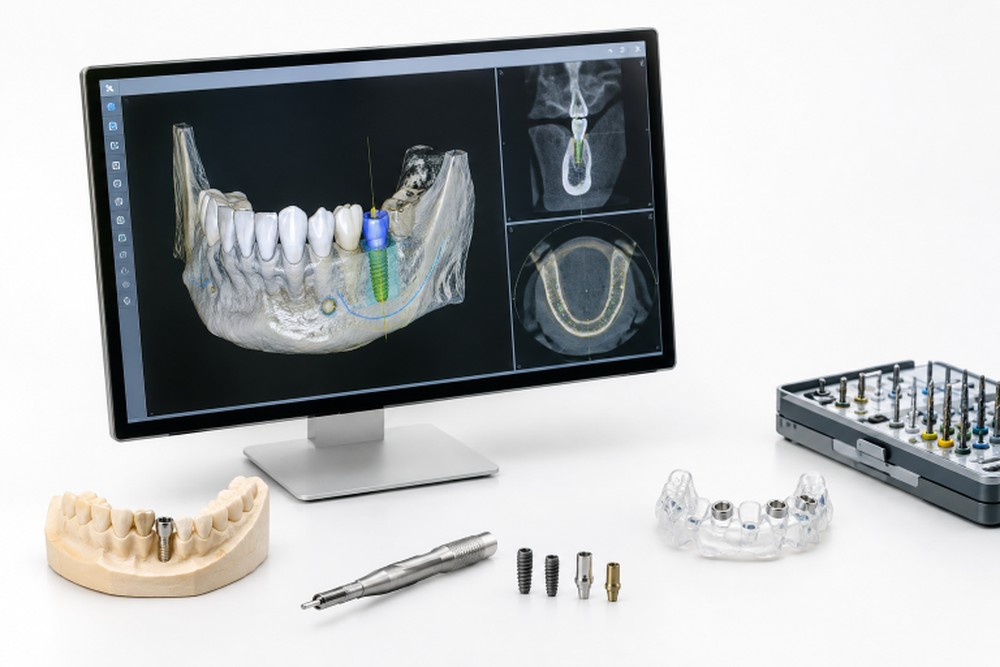
Replacing missing teeth requires more than choosing an implant. The dental team must consider the available bone, gum health, nearby nerves or sinus areas, the position of surrounding teeth, and the final crown, bridge, or full-arch restoration. Patients who want a digitally planned process can ask Ferber Dental about X-Guide dental implant surgery during an implant consultation.
Ferber Dental describes using detailed digital scans to plan implant placement and determine whether X-Guide navigation or Yomi robotic assistance is appropriate. The goal is not to select technology before an examination. It is to match the planning and surgical approach to the patient’s clinical needs, treatment goals, and restorative plan.
Why Precision Matters in Dental Implant Planning
Dental implants are placed in the jawbone to support replacement teeth. Their planned location, angle, and depth can affect how the final restoration fits, how forces are distributed during chewing, and how closely the procedure works around important anatomical structures. This is especially relevant for patients replacing multiple teeth or considering full-mouth implant treatment.
Digital planning gives the implant team an opportunity to evaluate the surgical and restorative sides of treatment together. Rather than viewing implant placement as an isolated procedure, the team can consider the desired tooth position first and then assess whether the jaw has sufficient bone and space to support that plan.
How Ferber Dental Plans Implant Treatment
Every implant case begins with an evaluation. Ferber Dental can review oral health, missing teeth, bone structure, medical history, medications, gum condition, and the patient’s goals for appearance and function. Additional imaging or digital scans may be recommended when needed for planning.
The next steps commonly include the following:
- Digital records: Scans and images provide information about the teeth, jaw, and proposed restoration.
- Implant position planning: The team assesses where implants may be placed in relation to available bone, the intended restoration, and nearby anatomy.
- Technology selection: The doctor determines whether dynamic navigation, robotic assistance, a static surgical guide, or conventional surgical methods are appropriate.
- Restorative coordination: The implant plan is considered alongside the design of the final crown, bridge, denture, or full-arch prosthesis.
- Follow-up planning: Patients receive guidance about surgery, healing, temporary teeth when applicable, and long-term maintenance.
What Is X-Guide?
X-Guide is a dynamic three-dimensional navigation system used during dental implant surgery. It connects the digital plan with live surgical guidance, helping the clinician monitor implant position, angle, and depth as placement proceeds. The clinician remains responsible for making surgical decisions and adapting the treatment when clinical circumstances require it.
Unlike a printed guide that is fabricated before surgery, dynamic navigation provides feedback during the procedure. That distinction may be helpful in cases where the doctor wants real-time guidance while maintaining flexibility to respond to the patient’s anatomy and the planned restoration.
How X-Guide and Yomi Differ
Both systems are intended to support implant surgery, but they work differently. Ferber Dental may discuss one or both approaches when reviewing a patient’s treatment plan.
- X-Guide: A dynamic navigation platform that provides real-time visual guidance for implant position, angle, and depth.
- Yomi: A robotic system that uses a semi-autonomous arm to help guide the surgical drill according to the treatment plan.
- Static surgical guides: Custom-made guides that transfer a preplanned implant position to the surgical site.
- Conventional placement: An approach guided by preoperative planning and the clinician’s surgical judgment without a navigation or robotic system.
No single method is automatically right for every patient. Bone volume, the number and location of implants, the type of restoration, medical considerations, and the complexity of the case can all influence the recommendation.
What Research Says About Guided Implant Placement
Research supports the value of computer-assisted planning and guidance, while also showing why patients should avoid treating any technology as a guarantee. A systematic review of guided and navigation implant surgery evaluated 56 studies and reported placement-accuracy measurements for both fully guided and navigation approaches. The review concluded that these approaches had implant survival rates comparable with historical controls.
Another systematic review and meta-analysis found different implant-failure rates among the studies it evaluated for guided and freehand placement. Those findings are useful context, but they do not predict an individual patient’s outcome. Bone quality, healing, oral hygiene, smoking, medical conditions, restorative design, and ongoing maintenance all remain important.
Who May Ask About X-Guide Implant Surgery?
An X-Guide dental implant surgery request may be appropriate for patients who are replacing one missing tooth, several teeth, or an entire dental arch. It may also be relevant for people seeking a second opinion, patients concerned about digitally planned placement, or those whose treatment involves limited available bone or close anatomical considerations.
However, not every patient needs navigated or robotic surgery. A thorough evaluation is needed to determine whether implant treatment is appropriate at all and, if so, which surgical method best supports the case.
How to Request an Implant Consultation at Ferber Dental
- Contact Ferber Dental and request a dental implant consultation.
- Tell the scheduling team that you would like to discuss X-Guide guided implant surgery.
- Bring relevant dental records, a medication list, and information about prior implant consultations if available.
- Complete any recommended examination, imaging, or digital scanning.
- Ask whether X-Guide, Yomi, a printed guide, or another method is recommended and why.
- Review expected appointments, restoration options, healing requirements, risks, alternatives, and estimated costs before proceeding.
Questions to Ask Before Dental Implant Surgery
- What implant approach is recommended for my case?
- How will my digital scans influence the treatment plan?
- Will I need gum treatment, tooth removal, or bone grafting first?
- What temporary and final restoration options are available?
- What are the possible risks, limitations, and alternatives?
- What home-care and maintenance will be needed after treatment?
Frequently Asked Questions
Can I specifically request X-Guide at Ferber Dental?
Yes. You can ask to discuss X-Guide during your implant consultation. The clinical team can determine whether it is appropriate after reviewing your oral health, anatomy, and treatment objectives.
Is X-Guide the same as a dental implant robot?
No. X-Guide is a dynamic navigation system. Yomi is the robotic system Ferber Dental describes as providing semi-autonomous assistance. Both can support implant placement in different ways.
Does guided implant surgery guarantee success?
No. Guided technology can support treatment planning and placement control, but surgical outcomes still depend on patient health, healing, hygiene, bone and gum conditions, restoration design, and follow-up care.
Conclusion
Patients interested in a carefully planned implant process can ask Ferber Dental about X-Guide navigation and Yomi robotic assistance. A personalized consultation allows the team to assess the clinical situation, explain the available treatment options, and recommend an approach that supports both implant placement and the long-term restoration.