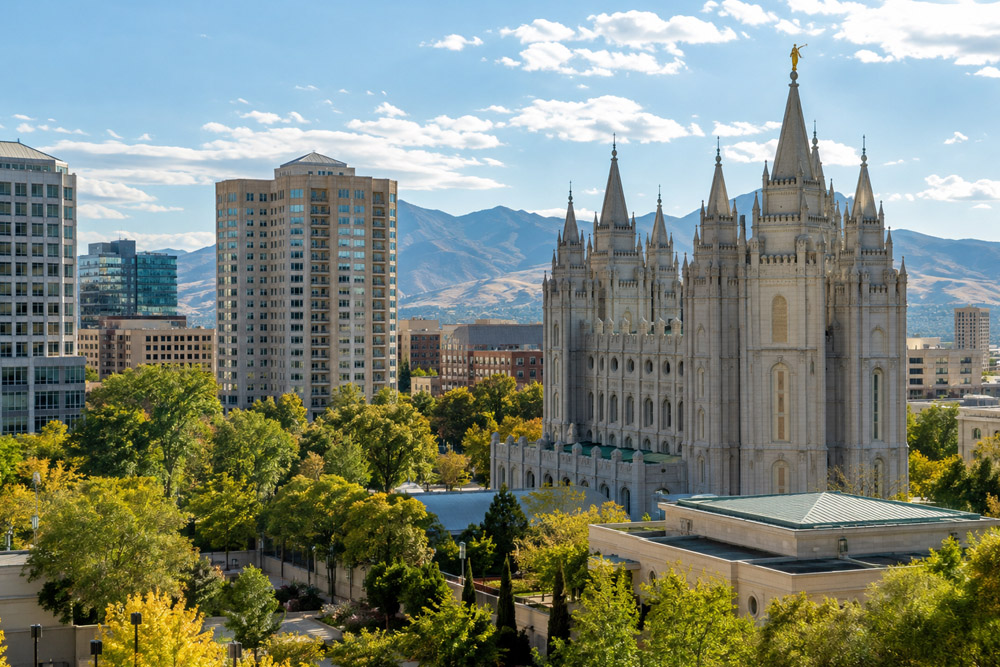
Plenty of cities make you learn street names. In Salt Lake City, it helps to learn the system behind them. Addresses here read like coordinates, blocks on the original grid are longer than many people expect, and the layout traces back to one corner downtown.
If you’re moving to Salt Lake City, that system is worth a few minutes before the boxes come out. It changes how you read a listing, how you give directions to a moving crew and how long “just down the block” turns out to be.
The Grid Starts at Temple Square
The city was laid out in 1847, and much of Salt Lake City still follows that basic pattern. According to an architectural history of the Salt Lake City plan, streets across the city and much of the surrounding region are numbered from the southeast corner of Temple Square, with Main Street serving as the north-south line and South Temple as the east-west one.
So 900 South is roughly nine blocks south of that corner, while 1300 East is roughly thirteen blocks east. Once it clicks, you can place most addresses in the city on a mental map without looking them up.
The catch is the house numbers. A home listed at 1150 East 900 South is on 900 South, roughly halfway between 1100 East and 1200 East. It’s easy to mix up which number is the street and which is the position on it. Confusing the two can make it harder to locate the correct address, especially for someone unfamiliar with the grid.
Big Blocks and Wide Streets
The same history describes the original blocks as 660 feet on each side, with streets 132 feet wide including sidewalks. That’s bigger than the blocks in many American downtowns, and it shows up in small, practical ways.
On the original grid, a 660-foot block is roughly an eighth of a mile. If a loading area, alley or parking spot is on the far side of a block, the carry between truck and door can stretch out more than you’d guess from the map. Wide streets can help with truck access in some spots, but parking rules and building policies still decide where a truck can stop.
Apartment and condo buildings are where this matters most. Many have their own rules about loading zones, elevator reservations or move-in hours, so it’s worth asking the building office before booking a time. The Salt Lake City team at Best of Utah Moving, for one, says its move plans account for building access, stairs, elevators and parking, which is the kind of detail to confirm with any company you’re considering.
Reading a Route on the Grid
The map above traces a drive from downtown to 859 South 600 West, and it doubles as a quick exercise in reading the grid. The address sits on 600 West, roughly six blocks west of Main Street, and its 859 South position places it between 800 South and 900 South.
Following the route on the map, you can match each cross street to its place on the grid. It’s the same logic you’d use to check a new address before giving directions to a crew or a delivery driver.
Beyond that route, a few areas newcomers tend to ask about:
- Downtown: The original grid at its most obvious, with large blocks, office towers and a mix of apartments and condos.
- The Avenues: Laid out in 1859 at roughly half the block dimensions of the older plat, with streets that rise toward the foothills north of downtown.
- Sugar House: A neighborhood southeast of downtown with its own business district and a large park.
- Central City and Liberty Park: Older homes and apartment buildings around Liberty Park.
- Rose Park and the west side: Residential neighborhoods west of I-15, with quick access to the airport.
Parts of the broader Salt Lake Valley also use the same numbered-street system, although the pattern becomes less uniform outside Salt Lake City.
Timing a Move Around the Downtown Calendar
Downtown Salt Lake City has a few dates that draw big crowds. General Conference at the Conference Center, held each April and October, can bring increased traffic and parking demand around Temple Square on conference weekends.
Pioneer Day on July 24 is a state holiday, and its parade runs through downtown streets. The Utah Arts Festival fills Library Square for several days in June as well.
None of these should stop a move. But if your new place is downtown or near the parade route, checking the date against the city’s event calendar can save you from a truck idling behind a road closure.
Utah Paperwork: Vehicles and Licenses Are Handled Separately
For most new residents, vehicle and license paperwork runs through two different agencies. The Division of Motor Vehicles handles vehicle titles and registration, and the Driver License Division handles licenses, so it helps to treat them as separate tasks.
On the vehicle side, the Utah DMV’s registration guidance says new residents have 60 days to transfer titles and registrations. Depending on the vehicle and county, a safety or emissions inspection may be part of that process, and the DMV’s inspection page is the place to check before you book.
The same page lists in-person appointment options at several offices, including Taylorsville and South Valley in Draper. Booking ahead tends to be easier than showing up during the busiest weeks of a move.
Settling In Around the Valley
Once the truck is gone, the grid gets easier every day. Liberty Park, south of downtown, has walking paths, a pond and Tracy Aviary, and it makes a good anchor for learning the surrounding streets on foot.
Sugar House Park offers paths and open space for longer walks, and City Creek Canyon has a trail that starts near the edge of the Avenues. Both are easy to find once you know which numbered street you’re on.
Keep the 60-day registration window on the calendar, and check building access, parking and local road closures before moving day.
If embedding is allowed, please insert this code into the HTML editor. On the live page, the map should display normally, and the embed code should not appear as text.