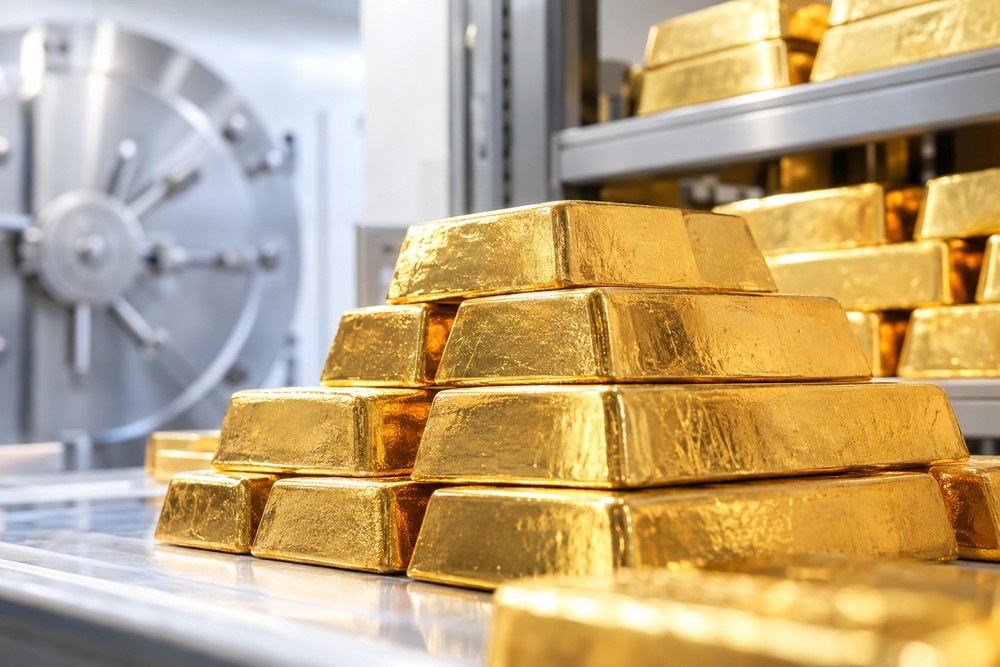
World Gold Council research shows that central banks around the world have been significant buyers of gold over the past few years. Once treated by some as a legacy holding from the era of gold standard, gold continues to play an important role in many national reserve portfolios. Understanding why many of the world’s monetary authorities are adding to their gold reserves offers valuable context for anyone trying to make sense of gold’s role in the broader financial system.
A Structural Shift, not a Passing Trend
The scale of official-sector buying over the past several years marks a genuine break from historical norms. According to World Gold Council supply and demand statistics, central banks have accumulated an average of roughly 1,000 tonnes of gold per year over the past four years, double the approximately 500-tonne annual average of the preceding decade. This acceleration has persisted through changing interest rate environments, shifting currency markets, and multiple geopolitical shocks, suggesting that gold has become an increasingly important consideration in reserve-management strategies.
The World Gold Council’s most recent Central Bank Gold Reserves Survey, which drew responses from 76 institutions, found that 89% of survey respondents expect global central bank gold holdings to keep rising over the next 12 months, and a record 45% said their own institution planned to add to its gold reserves. Both figures represent the highest levels recorded since the survey began.
Diversification Away from a Single Reserve Currency
In the survey, one of the top reasons central banks give for buying gold is the desire to diversify their reserves. For decades, the U.S. dollar has dominated global reserve holdings, but many central banks, particularly in emerging and developing economies, have been gradually rebalancing toward a broader mix of assets. Gold serves a diversification role because it is not a liability of any government or central bank. Unlike a foreign currency reserve, it carries no counterparty or issuer risk, meaning its value does not depend on another country’s fiscal policy, monetary decisions, or willingness to honor its obligations.
Data from the same survey points to a growing expectation among reserve managers that gold will play a larger role in reserve portfolios in the years ahead, even as the dollar’s traditional dominance is gradually reassessed.
Geopolitical Uncertainty and Reserve Security
Geopolitical tension has been a recurring theme in recent central bank surveys, and it is not difficult to see why. Recent sanctions imposed on national reserves in recent years have heightened attention to where reserves are held and the potential risks associated with assets held in foreign jurisdictions. Gold held domestically presents different custody and counter party considerations than foreign currency reserves held abroad. This has pushed a number of central banks to not only buy more gold but also to reconsider where and how it is stored; the World Gold Council survey showed that several institutions are moving reserves closer to home in recent years.
In addition, Brookings research in 2026 showed that emerging market and developing economies have accounted for virtually all of the recent central bank gold purchases. This broadening of the buyer base, rather than a concentration of demand among a handful of large economies, adds a further layer of durability to the trend.
Which Central Banks Are Buying Gold?
While the list of active buyers shifts from month to month, a consistent group of countries has anchored official-sector demand in recent years:
- China’s central bank has extended a lengthy streak of monthly gold purchases, lifting gold’s share of its total reserves to nearly 10%.
- Poland, Kazakhstan, and Uzbekistan have also been among the most persistent accumulators.
- In particular, Poland’s April 2026 purchases brought its gold reserves to around 30% of its total reserves.
- In January 2026, Malaysia’s central bank made its first net increase in gold since 2018.
A Hedge Against Inflation and Debt?
Beyond currency diversification and geopolitical positioning, central banks continue to view gold as a hedge against inflation and a safeguard against a backdrop of rising government debt. Gold has no yield of its own, but it also carries no default risk, which gives it a distinct role in a reserve portfolio during periods when confidence in sovereign debt or currency stability comes into question.
What This Means for Individual Investors
Central banks are, by design, conservative, long-horizon institutions. Their commitment to gold, even though periods of high prices and short-term volatility, offers a useful data point for individual investors evaluating gold’s role in their own portfolios.
For individuals researching physical precious metals, educational resources from companies such as Preserve Gold can provide additional information about physical gold and silver, portfolio diversification, and the considerations involved in owning precious metals. While individual investors have different objectives from central banks, some of the same topics – including inflation, currency risk, and diversification – can factor into their research.
Whatever the pace of buying in any given quarter, recent data show that gold remains an important component of reserve management for many central banks. : For those looking to understand gold’s enduring appeal, the actions of the institutions with the deepest pockets and the longest time horizons, backed by the research and educational resources available through Preserve Gold, speak louder than any single price forecast.