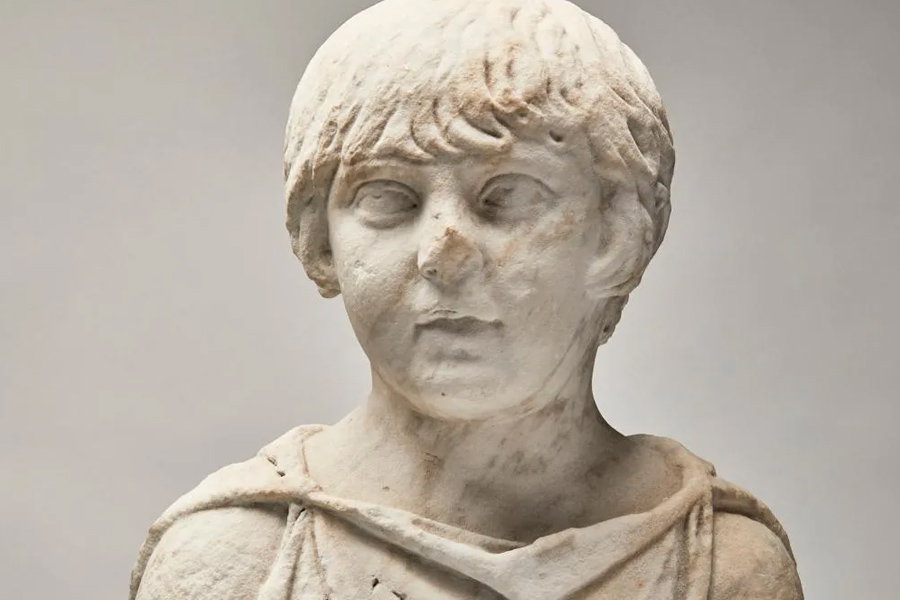
Basic Information
| Field | Details |
|---|---|
| Full Name | Marcus Annius Verus Caesar |
| Lifespan | 162/163 CE – 10 September 169 CE (age 7) |
| Birthplace | Rome |
| Parents | Emperor Marcus Aurelius and Empress Faustina the Younger |
| Dynasty | Nerva–Antonine |
| Title(s) | Caesar (proclaimed 12 October 166) |
| Co-heir With | Lucius Aurelius Commodus Antoninus (Commodus) |
| Siblings (selected) | Commodus (161–192), Lucilla (149–182), Cornificia (160–213), Fadilla (158–191), Vibia Aurelia Sabina (170–217), several others who died young |
| Known For | Being designated co-heir in childhood; death following surgery to remove a tumor |
| Historical Setting | Parthian War (161–166), Antonine Plague (from 165), high-water mark and approaching end of the Pax Romana |
A Brief Life at the Center of an Empire
Marcus Annius Verus Caesar was born into the most powerful household in the Roman world. His father, Marcus Aurelius, was both emperor and Stoic philosopher; his mother, Faustina the Younger, stood at his side through campaigns and ceremonies, serving as Mater Castrorum—Mother of the Camp—amid the empire’s wars. The child’s very name, Marcus Annius Verus, echoed his father’s original identity before imperial titles transformed it.
On 12 October 166, amid a triumph celebrating victory in the Parthian War, the toddler was lifted into public life. Alongside his brother Commodus, he was named Caesar—a promise cast in gold and marble that the Antonine house would endure. It was a dynastic gesture as much as a political one, securing the line during years when disease and conflict made even emperors look anxiously to the future.
But the boy’s life was short. In 169, after complications from surgery to remove a tumor under his ear, Marcus Annius Verus died at the age of seven. The candle that had been set in the windows of empire guttered quickly, and Commodus, already Caesar, was left to inherit alone.
The Family Web: Nerva–Antonine Ties
The Antonine household was not simply a family; it was the axis of imperial governance. Adoptions, marriages, and names threaded together the reigning line and Rome’s great houses, binding personal affection to public duty.
- Parents
- Marcus Aurelius (121–180): Emperor, Stoic author of Meditations, co-ruler with Lucius Verus, commander on the Danubian frontier.
- Faustina the Younger (c. 130–176): Empress, daughter of Antoninus Pius and Faustina the Elder, honored for her presence with the army and prolific motherhood.
- Grandparents
- Antoninus Pius (86–161) and Faustina the Elder (c. 100–140): Emperors of probity and peace; their adoptive arrangements placed Marcus Aurelius on the throne.
- Marcus Annius Verus (d. 124) and Domitia Lucilla (c. 97–155): Senatorial wealth and Roman industry—Lucilla’s brickworks bankrolled much of the family’s early standing.
Immediate Family Snapshot
| Relation | Name | Lifespan | Notes |
|---|---|---|---|
| Brother | Commodus | 161–192 | Later emperor; sole heir after Marcus Annius Verus’s death. |
| Sister | Annia Aurelia Galeria Lucilla | 149–182 | Empress as wife of Lucius Verus; executed after a failed plot against Commodus. |
| Sister | Annia Cornificia Faustina Minor | 160–213 | Lived into the 3rd century; connected to leading Roman families. |
| Sister | Annia Aurelia Fadilla | 158–191 | Married Marcus Peducaeus Plautius Quintillus. |
| Sister | Vibia Aurelia Sabina | 170–217 | Youngest; little is recorded of her later life. |
| Brother | Titus Aurelius Fulvus Antoninus | 161–164 | Died in early childhood; often identified as Commodus’s twin. |
| Siblings | Titus Aurelius Antoninus; Titus Aelius Aurelius | Died before 161 | Died in infancy; names honor adoptive imperial ties. |
| Brother | Hadrianus | c. 152–157 | Died young; name reflects the dynasty’s link to Hadrian. |
| Sister | Annia Galeria Aurelia Faustina | 147–165 | Died young. |
| Sister | Domitia Faustina | Died before 161 | Died in childhood. |
| Brother | Unnamed son | Unknown | Died in infancy; name not preserved. |
In a family of thirteen children, survival was uncertain even at the pinnacle of Roman society. The imperial nursery was crowded, but the fates were uneven.
Succession in a Time of Crisis
When Marcus Aurelius raised two small boys to the rank of Caesar in 166, he broke with his own precedent: he had not been styled Caesar until adolescence. The reason was stark. The empire faced the aftershocks of the Parthian War and the relentless Antonine Plague, which surged through cities and legions from 165 onward. Mortality struck high and low alike, and statecraft adapted.
By proclaiming both Commodus and Marcus Annius Verus as Caesars, the emperor made the line of succession redundantly clear. The ceremony took place during a triumph—a choreography of banners, laurel, and conquered kings—that married public celebration to private necessity. For the Romans, titles given to children were a hedge against chaos.
When Marcus Annius Verus died in 169, that hedge was cut in half. The succession line narrowed to Commodus, setting the stage for the troubled reign that followed Marcus Aurelius’s death in 180. In retrospect, the child’s passing looks like a hinge on which the era turned.
Medicine, Childhood, and the Fragility of Fortune
The cause of death—complications from surgery to remove a tumor under the ear—opens a window into Roman medicine. Court physicians were educated and experienced, heirs to Greek learning, but their tools were limited. Anesthetics were crude, antisepsis unknown, and infections common. A surgical wound near the ear could threaten the carotid, the jugular, and nerves essential to speech and swallowing. Even for a prince, survival could not be bought.
Childhood itself was precarious. In the second century, Rome’s infant and child mortality rates were high; epidemics like the Antonine Plague only sharpened the edge. The imperial household could secure tutors, doctors, and amulets—but not certainty.
Memory and the Measure of a Brief Life
Marcus Annius Verus left no laws, campaigns, or correspondence. He was too young to hold office or command troops. His life is a sketch rather than a portrait: a name in imperial ceremonies, a figure in family processions, a child who appears briefly on the stage before the curtain falls.
Yet even a shadow has shape. His designation as Caesar reminds us how Romans thought about legitimacy, continuity, and the spectacle of rule. His death restructured imperial expectations, leaving Commodus to bear the singular weight of succession. And his place within the Antonine line anchors many of the questions historians ask about dynastic planning in an age that prized adoption, prudence, and public virtue—until fortune, like a gust at sea, changed the course.
Timeline
| Year/Date | Age | Event |
|---|---|---|
| Late 162 or early 163 | 0 | Birth in Rome to Marcus Aurelius and Faustina the Younger. |
| 12 October 166 | 3–4 | Proclaimed Caesar alongside Commodus during the Parthian triumph. |
| 166–169 | 4–7 | Childhood amid the Antonine Plague and frontier mobilization. |
| 10 September 169 | 7 | Death following surgery to remove a tumor under the ear; Commodus remains sole heir. |
The Antonine House: Wealth, Work, and Public Image
The Antonine dynasty governed during the long tail of the Pax Romana, when prosperity and rule of law were Roman ideals, even as military strain mounted on distant frontiers. The family’s resources were vast: imperial revenues, estates, and the private wealth inherited from Domitia Lucilla’s thriving brickmaking enterprise.
Within this framework, children like Marcus Annius Verus were both beloved and instrumental. Education began early; their appearances at games, ceremonies, and religious rites formed part of the empire’s choreography. Titles bestowed on them—Caesar, princeps iuventutis—were promises to the public that continuity was assured, even if fate sometimes had other designs.
FAQ
Who was Marcus Annius Verus Caesar?
He was a son of Emperor Marcus Aurelius and Faustina the Younger, named Caesar in 166 beside his brother Commodus and designated as co-heir to the Roman Empire.
When and how did he die?
He died on 10 September 169 at age seven, following complications from surgery to remove a tumor beneath his ear.
Why was he named Caesar so young?
Amid the Parthian War and the Antonine Plague, naming child heirs was a precaution to secure dynastic succession and reassure the public.
Did he hold any offices or command armies?
No; he was far too young for active governance or military command, and his title was primarily ceremonial.
How did his death affect Roman succession?
His death left Commodus as the sole heir, a change that significantly shaped the politics of the later 2nd century.
Who were his most notable relatives?
His father Marcus Aurelius, his mother Faustina the Younger, his imperial grandfather Antoninus Pius, and his brother Commodus, who later became emperor.
Are there detailed records of his life?
Records are scant; he appears mainly in family lists, imperial ceremonies, and references to his early elevation as Caesar.