Indoor cornhole makes it possible to keep a favorite throwing game going when rain, cold weather, wind, or limited outdoor access gets in the way. Before setting up, choose equipment that fits the room and the players. A board and bag set from https://www.cornholeworldwide.com/ can support anything from relaxed family play to a more polished club or event setup.
The best indoor court is not necessarily a full regulation court. It is the court that gives players a clear lane, keeps people out of the path of a throw, and protects floors, walls, furniture, and nearby fixtures. With sensible spacing and simple house rules, cornhole can work well in basements, garages, recreation rooms, gyms, clubhouses, and event halls.
Why Indoor Cornhole Works
Playing indoors removes weather from the equation and provides a more predictable surface than wet grass, uneven ground, or loose gravel. Cornhole is built around tossing fabric bags toward raised boards, and the familiar game can be adapted for a smaller room without changing its basic appeal. The standard board dimensions and scoring approach are outlined in this overview of cornhole, but casual groups can agree on modified distances and formats before play begins.
Indoor play is especially useful for mixed-age groups. A family can set up a short practice lane in a finished basement, while a community center can designate several courts for league night. The key is to treat the room as a shared activity space, not simply place boards wherever they fit.
How Much Space Do You Need?
Measure before moving boards into the room. Adult regulation-style play commonly uses 27 feet between the front edges of the boards, but the overall court needs additional room for players to stand, retrieve bags, and move around each end safely. A practical full-size layout needs a long, open rectangle rather than only 27 feet of clear floor.
Check the following before deciding on a court location:
- Open distance between the boards.
- Walking space behind both throwing areas.
- Side clearance for players, scorekeepers, and spectators.
- Doors, stairs, columns, tables, and emergency exits.
- Ceiling lights, fans, sprinklers, pipes, and low-hanging decorations.
Building a Safe Indoor Layout
Keep the Throwing Lane Clear
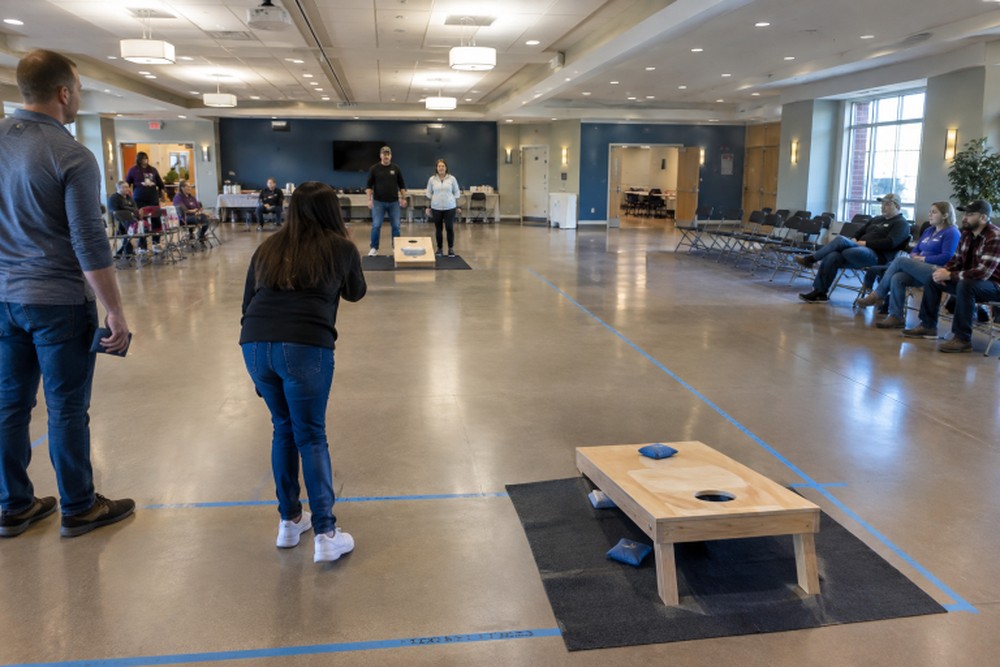
Put chairs, drinks, bags, cables, and personal belongings outside the court boundary. Spectators should stand behind the active thrower or along the side of the court, never in the open lane between boards. In workplace or public event settings, keeping passageways clear also reflects the basic walking-surface safety principles described by OSHA’s requirements for clean and orderly walking-working surfaces.
Mark Boundaries Without Creating Trip Hazards
Use low-profile painter’s tape, removable floor dots, or flat court markers to identify foul lines and spectator boundaries. Avoid raised rope, loose extension cords, or bulky objects that can catch a foot. If tape could damage the floor finish, test it in an inconspicuous area first.
Protect Walls and Overhead Fixtures
Move fragile items away from both boards before play starts. If a wall is close to a board, place a portable divider, padded barrier, or other non-breakable buffer behind it. Players should use smooth, controlled throws when ceiling fixtures are nearby, and the court should be relocated if bags could strike lights, fans, or sprinklers.
Choosing Boards, Bags, and Floor Protection
Most standard cornhole equipment can be used indoors, provided it is in good condition. Inspect bag seams and filling, check that board legs open securely, and make sure the boards rest evenly on the floor. Worn bags may leak filling, while unstable boards can shift during a game.
- Boards: Choose boards that sit flat and do not rock when a bag lands.
- Bags: Use clean, dry bags with intact stitching.
- Board feet: Add non-marking protective pads when using hardwood, tile, or polished concrete.
- Mats: Place thin rubber or non-slip mats beneath board feet if sliding becomes a problem.
- Lighting: Light both boards evenly so players can clearly see the hole and board surface.
Adjusting the Throwing Distance
A 27-foot distance is appropriate when the room provides enough clearance for adult regulation-style play. In smaller spaces, a shorter lane is usually safer and more enjoyable than squeezing players into a crowded court. Agree on the distance before the first round so every player uses the same line.
- 10 to 15 feet: A useful range for younger children, introductory practice, and compact rooms.
- 15 to 21 feet: A practical option for casual adult groups and mixed-skill events.
- 27 feet: Best for adult regulation-style play in a properly sized area.
Indoor Game Formats That Keep Things Moving
Long matches can create bottlenecks when several people share one court. For open play, use a first-to-11 format rather than a longer target score. Timed rounds also work well: set a 10- or 15-minute limit, finish the current frame, and record the result.
For a social event, try king of the court or partner rotation. In king of the court, the winning team stays while the next pair takes the open side. In partner rotation, players change teammates after each game. Both formats give newcomers more opportunities to participate.
Planning a Cornhole Event
A well-run indoor event starts with a short setup checklist:
- Measure and mark each court before guests arrive.
- Inspect boards, bags, floor pads, and boundary markers.
- Create a waiting area away from active throwing lanes.
- Post the chosen distance, scoring method, and game format.
- Explain that players throw only when the lane is clear.
- Assign someone to handle rotations, scores, and questions.
Common Indoor Setup Mistakes
- Using a full-length court in a room that does not have safe run-off space.
- Ignoring low ceilings or exposed fixtures above the court.
- Leaving bags, food, and chairs in walking paths.
- Allowing spectators to cross behind a target board during play.
- Skipping floor protection on finished or easily scratched surfaces.
- Making casual rules so complicated that new players cannot join quickly.
Frequently Asked Questions
Can cornhole be played in a small room?
Yes. Use a shorter throwing distance, remove fragile items, and keep the lane clear. A small room is generally better for practice or a compact family game than for a large tournament.
How can boards be kept from sliding indoors?
Start by confirming that the floor is clean and dry. If movement continues, use non-marking grip pads or thin nonslip mats beneath the board feet.
Is indoor cornhole suitable for children?
Yes, with adult supervision and a simplified layout. Shorten the distance, establish a clear throwing order, and keep children out of the lane until every thrown bag has stopped moving.
Final Thoughts
Indoor cornhole is most successful when the setup matches the space. Prioritize a clear lane, stable boards, protected flooring, good visibility, and a distance that suits the players. Those simple adjustments can turn an ordinary indoor room into a safe, welcoming place for year-round games.