Converting HDMI and QAM feeds into IPTV multicast creates a modern and adaptable television distribution platform. By transporting services over managed Ethernet and rebuilding CATV only where necessary, operators can extend the life of existing coaxial networks while gaining the flexibility of IP. The most reliable deployments combine suitable encoding and gateway equipment with disciplined multicast design, accurate bandwidth planning, controlled RF levels, and end-to-end monitoring. This produces a practical migration path from traditional CATV to a scalable, IP-centered television infrastructure.
Traditional television distribution systems rely heavily on dedicated coaxial infrastructure and RF equipment. Although these networks remain common in hotels, hospitals, campuses, apartment buildings, and commercial facilities, they can be difficult to expand and manage. A modern alternative is to convert HDMI and QAM sources into IPTV multicast streams, transport them over an IP network, and rebuild the required CATV lineup near the point of use.
This hybrid approach preserves compatibility with existing television sets while introducing the flexibility and scalability of IP-based distribution.
The Modernization Concept
The system separates television distribution into three stages: signal acquisition, IP transport, and local delivery.
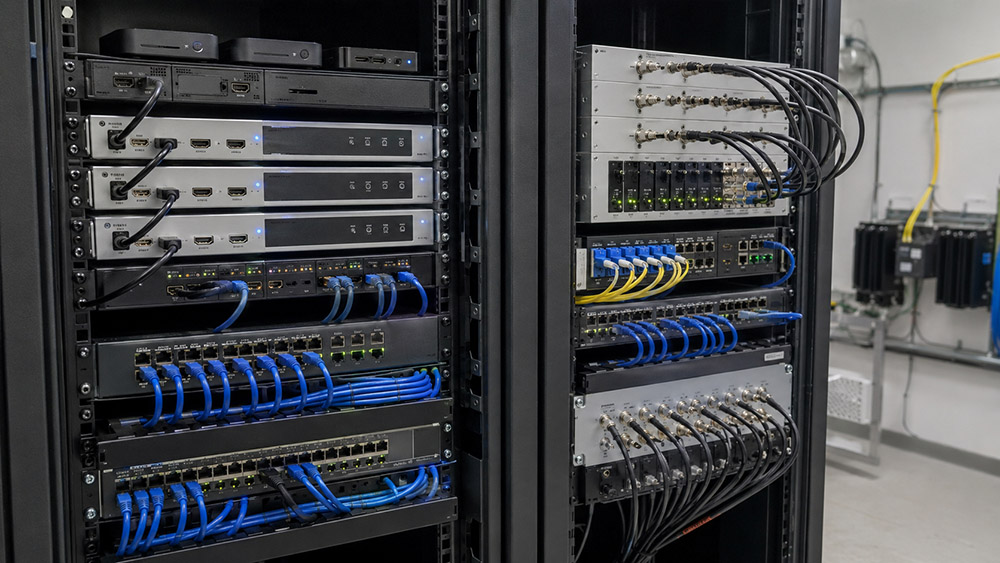
HDMI sources such as satellite receivers, media players, cameras, or information channels are connected to IPTV encoders. Existing QAM feeds are received by compatible gateways or professional tuners that extract the television services and convert them into multicast IP streams.
All channels then travel through the same Ethernet infrastructure. At remote locations, IPTV receivers or IP-to-QAM gateways convert the streams into the format required by televisions and the existing coaxial network.
The result is a flexible architecture in which IP becomes the central transport layer, while HDMI and RF remain available at the network edges.
Converting HDMI Sources to IPTV
An HDMI encoder captures digital video and audio from a source, compresses them, and packages the resulting program into an IP stream. H.264 remains widely supported, while H.265 can reduce bandwidth requirements when compatible receiving equipment is available.
For professional installations, encoders should support stable multicast transmission, configurable bit rates, audio encoding, resolution scaling, and continuous operation. Depending on the application, a single device may encode one HDMI source or multiple independent channels.
Each service is assigned a unique multicast group address and usually a UDP port. Instead of sending a separate copy of the channel to every viewer, the encoder transmits one stream that can be replicated by network switches wherever it is requested.
Migrating Existing QAM Services
An existing QAM feed may contain several digital television programs within a single RF channel. A QAM-to-IP gateway tunes the required frequencies, demodulates the signals, and makes the underlying transport streams available over Ethernet.
The gateway may forward complete multiplexes or selected programs. Service filtering can reduce unnecessary network traffic, while remultiplexing allows programs from different inputs to be reorganized into a new channel structure.
Before migration, operators should document the existing lineup, frequencies, modulation parameters, program identifiers, encryption status, and source ownership. Encrypted programming may require authorized conditional-access equipment and cannot always be processed by a standard gateway.
Designing the Multicast Network
IPTV multicast depends on correct network configuration. Managed switches should support IGMP snooping, which ensures that television streams are forwarded only to ports with active viewers. Without it, multicast traffic may behave like broadcast traffic and unnecessarily load every connected device.
An IGMP querier must also be present in each relevant network segment. It maintains multicast group membership information and prevents forwarding tables from expiring incorrectly.
Additional design considerations include:
- Dedicated VLANs for IPTV traffic.
- Sufficient bandwidth on access and uplink ports.
- Quality-of-service policies for video streams.
- Consistent multicast addressing.
- Monitoring of packet loss, jitter, and interface errors.
- Redundant links and power supplies where service continuity is critical.
Bandwidth should be calculated from the combined bit rate of all simultaneously transported channels, not from the number of viewers. Additional capacity should be reserved for protocol overhead, variable bit-rate peaks, and future services.
Rebuilding CATV at Remote Locations
Where existing televisions cannot receive IPTV directly, an IP-to-QAM gateway can reconstruct a conventional CATV lineup. The gateway subscribes to selected multicast streams, multiplexes the programs, modulates them onto QAM carriers, and delivers the resulting RF signal to the local coaxial network.
This allows facilities to retain installed televisions, splitters, taps, and coaxial cabling while replacing long RF backbone links with Ethernet or fiber.
The rebuilt lineup does not have to reproduce the original frequencies exactly. Channels can be reorganized to make more efficient use of the available RF spectrum. However, the final plan must remain compatible with the tuning range and QAM standards supported by the receiving televisions.
Correct RF output levels are essential. The combined signal must account for combiner loss, cable attenuation, splitters, taps, and amplifier gain. Excessive levels can overload receivers, while insufficient levels can reduce the modulation error ratio and cause picture interruptions.
Supporting Native IPTV Reception
Some sites may gradually replace conventional televisions with smart displays, set-top boxes, or hospitality receivers that support IPTV multicast. These devices can subscribe to streams directly, eliminating the need to rebuild QAM locally.
A mixed environment is also possible. The same multicast services can feed native IPTV receivers in one area and an IP-to-QAM gateway in another. This supports phased modernization without requiring every television or building to be upgraded simultaneously.
Key Operational Benefits
Using IP as the transport layer provides several advantages:
- Centralized channel acquisition and encoding.
- Efficient delivery of one stream to many viewers.
- Easier expansion across buildings and locations.
- Reduced dependence on long coaxial trunk networks.
- Flexible channel selection at each remote site.
- Integration of local HDMI content.
- Compatibility with both IPTV and traditional CATV receivers.
- Improved monitoring and remote configuration.
The architecture also simplifies future changes. Adding a channel may require only a new multicast stream and configuration updates rather than physical RF modifications throughout the facility.
Testing and Deployment
A staged rollout reduces risk. Engineers should first verify each encoded stream for resolution, audio synchronization, bit rate, and stability. The multicast network should then be tested under realistic load, including simultaneous channel subscriptions.
At the RF output, measurements should include carrier level, modulation error ratio, bit error rate, frequency accuracy, and performance at representative television outlets. Channel scanning and program mapping should be verified on every important receiver model.