A slow drain in the morning seems minor. By Thursday it backs up completely, and suddenly your weekend is a plumber’s invoice. That pattern plays out constantly for homeowners across the Big Island, Oahu, and Maui, and almost every time, the fix would have cost a fraction of what emergency repairs end up running. Catching the early signals is the whole game. Here are seven warning signs worth taking seriously, plus a framework for deciding when you need a professional right now versus when you have a little room to wait.
Why Hawaii Homes Face Unique Plumbing Pressure
Salt air corrodes pipe fittings faster than most mainland homeowners ever experience. High humidity accelerates the growth of mold behind walls where slow leaks hide. And on the Big Island specifically, many rural and upcountry properties rely on catchment tank systems, which add a pump, filtration, and pressure tank to the chain of components that can fail. When the pressure tank loses its charge or the pump draws air instead of water, symptoms often look like a drainage problem when the real issue is on the supply side entirely.
That Hawaii-specific complexity is exactly why the warning signs below are listed in order of urgency, not alphabetical order or some arbitrary ranking. Read them that way.
Warning Sign 1: Water Pressure Drops Without Explanation
Pressure that falls gradually over several weeks usually points to mineral buildup inside supply lines, a common issue in areas with hard water. Pressure that drops suddenly points somewhere else: a partially closed shutoff valve, a developing slab leak, or, in catchment homes, a failing pressure tank bladder. Either way, you’re looking at a cause that won’t resolve itself.
Don’t ignore it because water still comes out. A slab leak running undetected for weeks can compromise a concrete foundation and create conditions for mold growth inside walls that you won’t see until the damage is already expensive.
Warning Sign 2: Discolored Water From the Tap
Brown or orange water typically means rust inside an aging water heater tank or corroding galvanized pipes. In areas with catchment systems, sediment can enter the supply line after heavy rain stirs up the tank bottom. Either source is worth investigating promptly.
A brief rust tinge after your water heater hasn’t been used for a few days is less alarming than persistent discoloration every time you run the tap. If it’s every time, the tank’s anode rod may be depleted, or the tank itself is corroding from the inside out. Tankless heater replacement or repiping solves this, but only after a proper diagnosis.
Warning Sign 3: Sounds Inside the Walls at Night
Running water you can hear when nothing is turned on is one of the clearest signals in plumbing diagnostics. Turn off all fixtures, check that no appliances are pulling water, and listen near walls where supply lines run. A hissing or dripping sound that persists for more than ten seconds almost certainly means an active leak somewhere in the line.
Banging sounds, on the other hand, usually signal “water hammer,” which happens when a fast-closing valve causes a pressure surge in the pipe. Installing hammer arrestors fixes it, but the banging itself can fatigue pipe joints over time, so it’s worth addressing before it causes a secondary problem.
Warning Sign 4: Slow Drains Across Multiple Fixtures
One slow drain is usually a local clog near the drain opening. Two or more slow drains in different rooms at the same time point further down the line, toward the main sewer or septic connection. Tree root intrusion, grease accumulation, and partial pipe collapse all show up this way first.
Hydro jetting clears most of these situations without excavation. Trenchless sewer repair handles the cases where jetting reveals structural damage. The worst outcome is ignoring it until a complete backup forces the issue, because that’s when you’re also dealing with contaminated water on your floor.
Warning Sign 5: Your Water Bill Climbs for No Obvious Reason
This one is underrated as a diagnostic tool. According to the U.S. Environmental Protection Agency’s WaterSense program, the average household’s leaks can waste nearly 10,000 gallons of water per year, and fixing those leaks saves homeowners an average of 10 percent on their water bills. A water bill that ticks up even 8 to 12 dollars per month without a corresponding change in usage habits is enough to justify a leak detection check.
Start with your meter. Turn off every fixture and appliance in the house and watch the meter dial for two minutes. Movement means water is moving somewhere it shouldn’t be.
Warning Sign 6: Wet Spots, Staining, or Soft Spots in Flooring
A soft spot in a wood floor near the bathroom, a water stain on the ceiling below an upstairs bathroom, or damp drywall near a kitchen cabinet are all forms of the same message: water has been going somewhere wrong for long enough to show up visibly. By the time you can see it, the damage behind the surface has usually been building for weeks.
This is the scenario where calling a kailua-kona plumber with leak detection equipment pays for itself immediately. Thermal imaging and moisture meters identify exactly where the water is traveling without tearing open walls blindly, which saves on both repair time and drywall costs.
Warning Sign 7: Age Combined With No Maintenance History
A house that’s 25 or more years old with original supply lines and a water heater that’s never been flushed is a house with a maintenance debt. Galvanized steel pipes have a typical lifespan of 20 to 50 years, with corrosion accelerating in coastal salt-air environments like most of Hawaii. A water heater running past 12 years on the Big Island is statistically close to end of life even if it hasn’t shown symptoms yet.
Getting a licensed plumber to do a full system inspection before something fails is almost always cheaper than an emergency call after it does. The U.S. Bureau of Labor Statistics projects plumbing employment to grow 4 percent from 2024 to 2034, reflecting consistent demand driven by aging housing stock across the country. That demand isn’t slowing down, and neither is the cost of emergency service calls.
The Big Island Plumbing Warning Matrix
Use this table to gauge urgency. It’s built around the Hawaiian homeowner context, not generic mainland advice.
| Warning Sign | Likely Cause | Hawaii-Specific Factor | Urgency Level
|
| Sudden pressure drop | Slab leak or shutoff valve failure | Catchment pump loss | Call same day |
| Persistent discolored water | Corroding tank or galvanized pipes | Catchment sediment after rain | Call within 48 hours |
| Running water sounds in walls | Active leak in supply line | Salt-air pipe corrosion | Call same day |
| Multiple slow drains | Main line clog or root intrusion | Lava rock soil around sewer lines | Call within 24 hours |
| Rising water bill | Hidden leak | High water costs make waste expensive | Schedule within one week |
| Wet spots in flooring | Long-running concealed leak | High humidity accelerates mold | Call same day |
| Old system, no maintenance | Multiple approaching failures | Coastal corrosion shortens lifespans | Schedule inspection this month |
What to Do Right Now
Run through this quick check before you call anyone:
- Check the water meter with all fixtures off. Any movement means an active leak.
- Feel along the base of your water heater for moisture or rust staining on the floor beneath it.
- Press gently on the flooring near every toilet and sink. Softness means water has gotten under the surface.
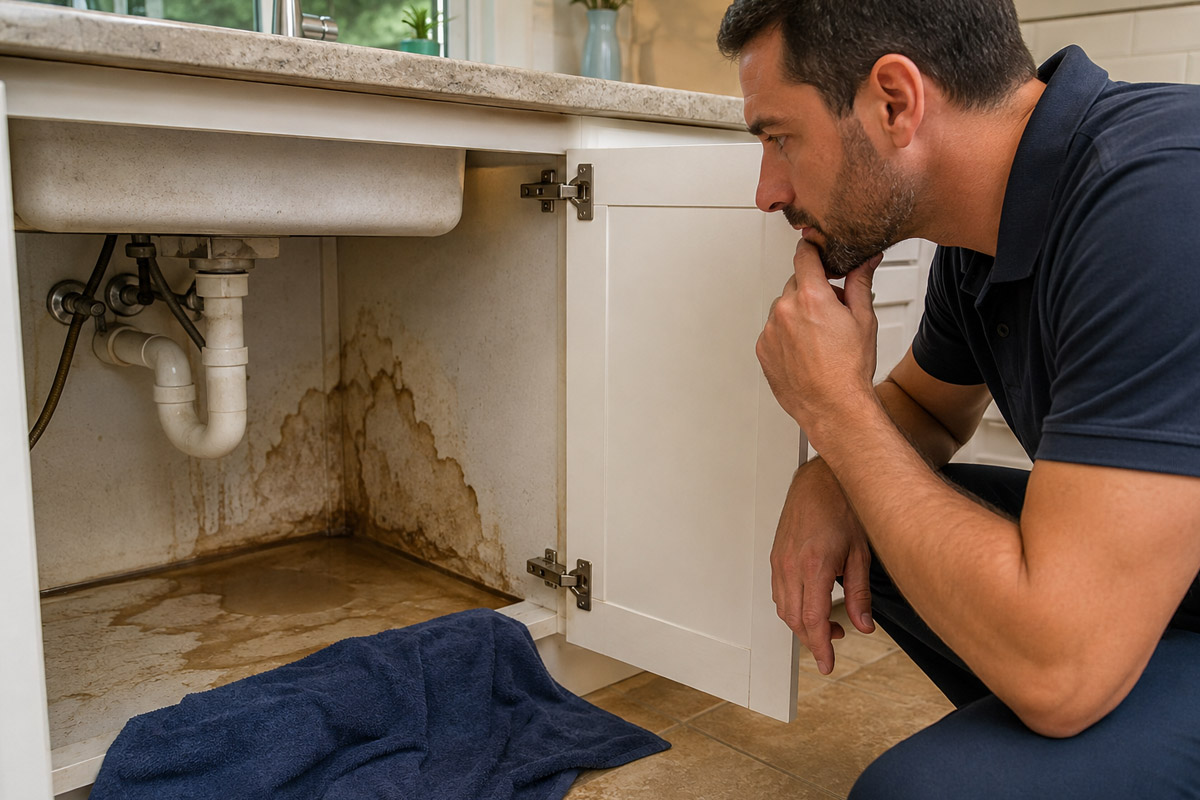
- Pull open cabinets under kitchen and bathroom sinks and look at the back wall. Dark staining or a musty smell tells you there’s been moisture intrusion.
- Know how old your water heater is. The manufacture date is usually on the label on the tank itself.
“Leaks that go undetected for months are almost always the ones that become the most expensive repairs. The warning signs were there, they just weren’t recognized for what they were.” This reflects the consistent professional consensus among licensed plumbers and home inspectors who work with older residential housing stock in high-humidity coastal climates.
None of these checks require tools or plumbing knowledge. They take about ten minutes and they give you real information before any conversation with a contractor starts.
The goal isn’t to avoid calling a plumber. Plumbing is genuinely technical, and botched DIY repairs on supply lines or sewer connections regularly create worse problems than the originals. The goal is to call at the right moment, with enough information to describe what you’re seeing, so the diagnosis starts faster and the repair scope is clearer from the first visit. Hawaii’s homes are too valuable, and the cost of water damage too significant, to let a slow drip run until Thursday.