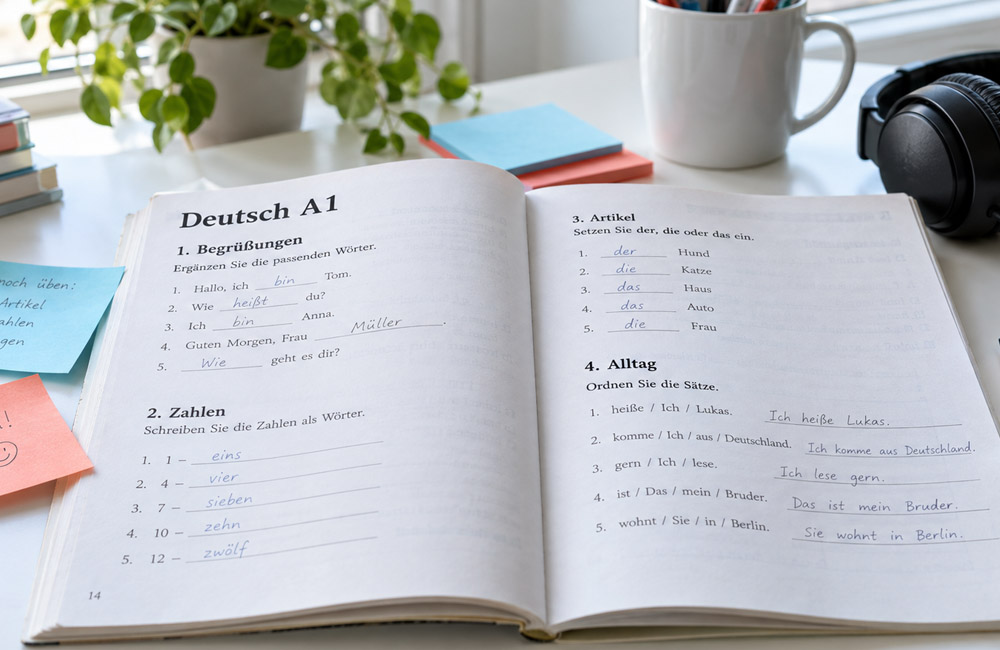
Starting German from zero raises one question fast: what level are you at right now? An A1 German test answers it. The test checks how well you handle basic words, simple phrases and everyday situations, then places you on the beginner step of the Common European Framework of Reference for Languages, known as CEFR. Learners at this stage usually know fewer words. That number gives you a clear base for choosing what to study next.
What the Test Measures
The test focuses on the language you need in the first weeks of learning. Questions cover vocabulary, basic grammar and short reading tasks. Expect topics such as greetings, numbers, days of the week, food orders and personal details.
The Council of Europe describes an A1 user as someone who can introduce themselves and ask simple personal questions. That person can also answer them and take part in a basic conversation when the other speaker talks slowly and clearly. The test checks for exactly these skills.
How the Score Places You
CEFR uses six levels from A1 to C2. Your result shows where you sit on that scale.
- A score in the A1 range confirms you have a working beginner base.
- A score below it means you should review core words and sentence patterns first.
- A strong A1 result shows you are ready to move toward A2 and a vocabulary of roughly 1,500 to 2,000 words.
The result works like a mirror. It shows what you know now and what to practice next.
Who Gets the Most Value From It
Different learners use the same result in different ways:
- Beginners confirm their progress after a few weeks of study.
- Students pick the right course level before they pay for one.
- Job seekers add a verified certificate to a resume or LinkedIn profile.
- Future expats check their readiness before a move to Germany, Austria or Switzerland.
Teachers use scores too. A clear level helps them choose textbooks that match a learner’s real ability.
How to Prepare in One Week
You do not need long study sessions. Short daily practice works better.
- Learn the most common 100 words such as haben, sein, Wasser and Haus.
- Practice the articles der, die and das with every new noun.
- Read simple texts like menus or train signs.
- Take a timed practice run so the format feels familiar.
Mistakes are normal at this stage. Note them and review them the next day.
Conclusion
An A1 German test turns a vague feeling about your German into a clear level. You see your strengths and your gaps. Then you can plan the next stage with confidence.
Testizer offers a free online German test that follows CEFR standards. The test has 25 multiple-choice questions and takes about 25 minutes on a laptop, tablet or phone. You need no microphone or speakers. Your result appears right away, and the certificate arrives by email. Each certificate carries a QR code so employers can verify it in seconds. Take the test today and see where you stand.