A datasheet provides useful information about the performance of a sealing compound, but this information shouldn’t be your only consideration. The following factors may affect the performance of a seal and should be evaluated when determining which elastomer material will best suit an application:
- Constant or intermittent temperatures
- Pressurised or vacuum environments
- Presence of chemicals, lubricants, fluids, vapours, particulates etc.
- Repeated cold-hot cycles
- Steam or cleaning agents
- Static, reciprocating or rotating seals
Datasheets typically give a maximum and minimum temperature rating for a range of elastomer materials. Whilst useful, these ratings are not definitive as they’re often determined under specific test conditions that may not necessarily reflect real-world scenarios. For example, some elastomers may perform well at elevated temperatures, but can suffer a loss of flexibility when subjected to cold-hot cycling. Similarly, whilst an elastomer may have a suitable temperature rating, it may react adversely with certain chemicals or lubricants and suffer from accelerated hardening, embrittlement, cracking and swelling.
When specifying a seal, it’s important to consider not only the temperature rating of an elastomer, but also the environment in which it will be operating. Datasheets can provide designers and maintenance engineers with a good starting point, but the success of a seal will be determined by how well it performs in situ.
Heat Changes More Than Hardness
As the temperature increases, elastomer materials can suffer from a number of issues including hardening, loss of tensile strength, compression set and surface cracking. Compression set can cause problems in static applications because the seal may no longer recover from compression or maintain contact with the sealing faces, as explained in https://en.wikipedia.org/wiki/Compression_set. This can result in leakage despite the seal appearing serviceable.
At lower temperatures, elastomers can stiffen and may struggle to conform to surface imperfections. This can prove problematic at start up after cold storage where a pressurised system is started immediately.
Temperature Must Be Read Alongside Chemical Compatibility
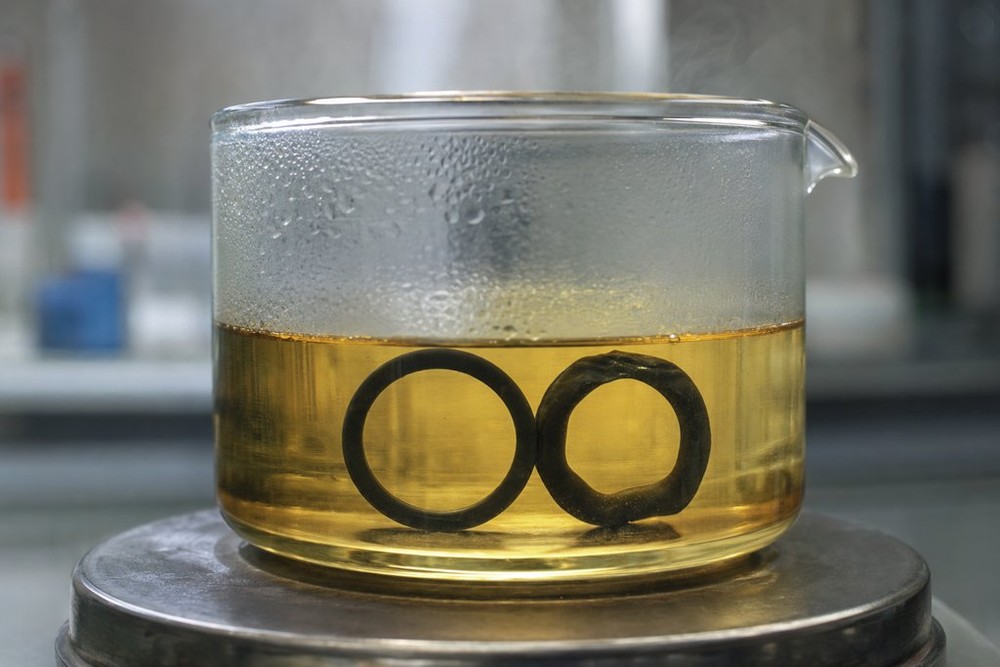
Seals can react adversely with hot chemicals, oils, fuels, solvents, steam, water etc. Datasheets can indicate compatibility by showing changes in hardness and volume as well as providing general guidance. Other considerations include:
- Chemicals used during cleaning cycles may be more aggressive or applied at higher temperatures than process fluids
- Minor constituents can have a greater affect than the major fluid
- Temporary overheating can cause permanent damage before it’s identified
- Prolonged storage can affect seals prior to installation
Whilst temperature ratings are a good place to start when specifying a seal, these figures should not be considered in isolation. Other parameters such as chemicals, pressure, temperature cycling, movement etc. should all be considered to determine the best elastomer material for the task.
Mechanical Conditions Can Narrow the Usable Window
Other considerations include:
- Extrusion – seals can extrude into gaps between sealing faces particularly at high pressures when the material is at its softest (usually at high temperature). Always check the extrusion gap at maximum pressure and temperature.
- Interference fit – seals may be pinched in the seal groove if there isn’t sufficient room to allow for thermal expansion. Alternatively, large grooves can allow movement resulting in rolling or extrusion of the seal.
- Friction – frictional heating can result in significantly higher temperatures at the seal face than at the equipment. Ensure that the system can dissipate the heat generated if drag is anticipated during operation.
Read Material Sheets Without Overpromising
Elastomer datasheets provide an indication of chemical compatibility as well as guidance on temperature range, hardness, tensile strength, elongation, compression set etc., and O-Ring temperature range is one of the core limits used to screen candidate materials. This information is useful when eliminating unsuitable materials but should not be relied upon to indicate seal life.
Always check the test conditions that the data has been acquired in. For example, has compression set been determined after an extended period of time or just a few hours? Is the maximum temperature rating for continuous or intermittent usage? With which fluid was the testing performed?
If pressure swings are expected to be rapid, it may be advisable to assess the seal’s temperature rather than the bulk fluid temperature since:
- Expansion of the gas may result in rapid cooling of the seal gland and elastomer.
- Short periods of high loading may give rise to localised heating effects that are not picked up by temperature monitoring devices.
Appropriate instrumentation, trial assemblies and consideration of inspection intervals may all help in establishing if these transient conditions fall outside normal operating ranges.
Build the Real Operating Profile
If possible, gather as much information as you can about the application prior to specifying a seal including maximum and operating temperature (and duration), maximum and operating pressure, chemicals encountered (including cleaning solvents), type and speed of movement, anticipated overhaul period etc. This will enable future failures to be analysed more effectively.
Take a look at the datasheet for your chosen elastomer material. Is it suitable for your application?
Temperature can have a dramatic effect on the performance of elastomer materials. Always consider the complete operating envelope (including extremes) when specifying a seal material.