Attic code failure means your home falls below South Florida’s minimum attic insulation level. Humidity speeds attic failure. Florida code often sets that minimum at R30 in Broward County attics. Attic air leaks and thin insulation leave many South Florida homes below code, raising heat gain and moisture risk indoors.
Your cooling bills rise. That starts with comparing common South Florida insulation materials to code.
Compare Common Insulation Materials for South Florida Attics
This table compares four key points, and it shows where they fit for attic insulation in Broward County, per Chris Curry.
| Material | What you get | Main limit |
| Closed cell Spray Foam Insulation | R6 to R7, tight air seal, moisture resistant, long life | Needs skilled install; it can hide roof leaks behind the foam |
| Open cell Spray Foam Insulation | R3.5, fills odd gaps, helps with sound, bends into hard spots | Not moisture proof, and it is less tough in rough weather |
| Blown-In Insulation with cellulose | R3.5, recycled paper, borate treated, reaches tight areas | Can hold water, sag with weight, and lose full coverage |
| Fiberglass Insulation batts | Common in Florida, fire and water resistant, easy to place | They can leave gaps in complex attics, so air slips through |
Checklist Steps to Verify Attic Insulation Compliance
Use these five checks first.
- Walk only on joists or truss chords before you check anything. Nails can point up through the ceiling or down from the roof deck.
- Look across the attic floor and note whether the insulation sits at, below, or well above the joists. Visible joists often mean you are short.
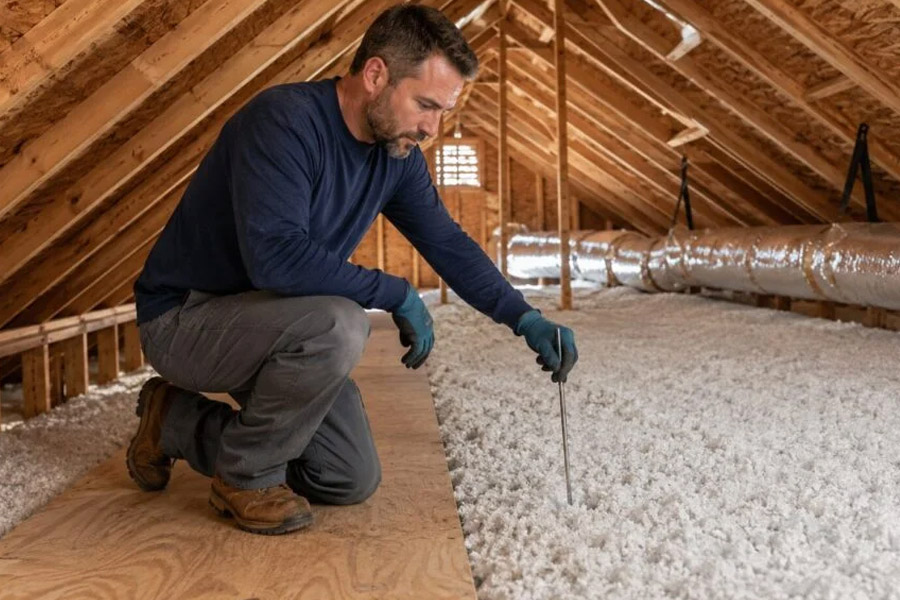
- Measure attic insulation depth in several spots with a tape. You can use the quick R 3 per inch screen from the federal guide.
- Check that the coverage stays even from the center to the eaves. You will find many South Florida homes fail where the edges go thin.
- Read the printed R value on any batt insulation and compare it with your depth notes. You may find mixed readings often explain why older homes miss the minimum attic insulation code.
- Inspect for light at attic floor gaps while the house is lit inside. If you see light through cracks, it shows leaks that can weaken overall code fit.
Frequently Asked Questions Broward Attic Code Failures
Here are four common questions with clear answers.
- What does an attic code failure mean? It means your attic insulation is below the low mark tied to your permit or the code used for your job. If it is low on installed R value, you will not pass as built.
- Why do older Broward homes fail more often? If your home was built under older standards, its attic levels may fall short today. You may have insulation in place, but it can still miss the current minimum.
- Why is the attic a code focus? The ceiling below your attic is a main path for outdoor heat, and your cooling and heating use about 52% of home energy, according to the Florida Department of Agriculture and Consumer Services. That is why your attic insulation gets close review.
- Is more insulation alone enough? Not always. The Florida Department of Agriculture and Consumer Services says your attic insulation and air sealing work together to cut cooling costs and boost comfort.
Common Mistakes Leading to Insulation Code Violations
The section lists four mistakes that can cause South Florida attics to miss code.
- Too little insulation: You fail to meet code when attic insulation stops below the required R-value.
- Wrong code goal: You fail to meet code when you think every South Florida attic can stop at R30.
- Wrong exception: Under the Florida Energy Conservation Code, R30 works only if it runs across the full ceiling and eaves or if space is too tight for R38.
- Old rule book: You can still fail if your plans do not follow the FECC 7th edition, updated in 2020 from the 2018 IECC.
Heat Transfer Problems in South Florida Attics
Those misses usually trace back to one problem: heat flow in South Florida attics. That heat moves indoors fast. The U. S. Department of Energy says heat flows to cooler spaces, so your attic keeps pushing heat into the rooms below. Radiant heat is a big part of it. The problem goes beyond radiant heat. When insulation is thin or uneven, ceilings feel hotter, and rooms retain heat late into the evening. That is why many South Florida homes miss the minimum attic insulation code, even though they look fine.
Moisture Damage Risks from Inadequate Insulation
Beyond attic heat, these four moisture risks help explain why many South Florida homes miss minimum attic insulation code.
- Condensation on cold ducts: If attic insulation is too thin, humid attic air can hit cooler duct surfaces, notes that the risk of sweating increases when the attic stays near 90% humidity for hours.
- Wet insulation that stops working: Once insulation holds moisture, it loses depth and performance, so your attic insulation may fall short of the code level on paper and in real use.
- Trapped attic humidity: If you seal or insulate the wrong plane, you risk moisture staying in the attic and making wood, fasteners, and roof decking more vulnerable to decay.
- Part-time moisture spikes you miss: A low-cost humidity monitor can show whether you have long damp periods, because they can happen while you sleep or while the home sits empty.
Air Leakage Issues Around Penetrations and Vents
Most code failures start when attic air leaks through openings. After damp signs show up, you should next look at lights, pipe gaps, attic hatches, wiring holes, and bath fan housings. They add up fast. The U. S. Department of Energy says air sealing comes first. That order matters because attic insulation alone will not stop indoor air from slipping through ceiling cuts. These vent paths can also cause code failures.
EPA guidance says bath exhaust should vent outdoors, and in South Florida, if you vent it into the attic, you often miss code.
Upgrade Costs for Attic Insulation in Broward Homes
Upgrade costs rise quickly when your attic insulation is too thin and needs correction. After Air Sealing, costs vary. In Broward homes, you often pay more when old fill is wet, thin, or crushed and must be removed first. Material choice also affects cost. The International Energy Conservation Code places Florida in Climate Zone 1. There, removal of old insulation, added depth, and fresh Air Sealing often drive your upgrade cost more than the insulation alone.
If your attic remains too thin, you can still fail to meet minimum attic insulation code requirements.
Compare Attic Insulation Types vs Local Code Requirements
You can compare four attic code points below.
| Insulation type | Local code check | What you should know |
| Fiberglass Insulation batts | Must keep full depth and the required total R value across the attic floor. | If they are crushed or leave gaps, you can fail even with the right label. |
| Blown-In Insulation | Must show even depth and enough installed material to reach the minimum R value. | It fills odd spaces well, but low spots near edges still count against you. |
| Spray Foam Insulation | Must meet the required R value where it is applied and stay sealed at the edges. | PREC notes that breaks in an air barrier let heat bypass insulation, so coverage matters as much as type. |
| Layered attic insulation | Code looks at the total R value of all layers together. | PREC says R value measures resistance to heat flow over time, and layered R values add together. |
Older South Florida homes often fail minimum attic insulation code. Age and air leaks matter. Builders followed older standards, and later insulation settling plus attic leaks cut effective R value in many homes. That mix leaves you with hot rooms, higher bills, and failed inspections. Code alone is not enough. The U. S. Department of Energy says you get better results when you seal air leaks first, so Air Sealing matters.
Broward attics favor Fiberglass Insulation, while sealed rooflines may justify spray foam. Schedule a Broward Insulation Service attic audit.