Round loads never sit where you expect them to
Anyone who has carried a bundle of pipe or a stack of poles on bare forks has watched the top piece roll off somewhere between the pile and the truck. Round material has no flat face to rest on and no edge to catch, so it redistributes itself every time the machine moves or the ground tilts. A pallet fork pipe grapple exists because clamping that kind of load is a different problem from lifting a pallet.
One jaw cannot touch everything at once
Picture a single wide jaw closing onto five pipes of slightly different diameters. It meets the tallest one first, and everything after that is the hydraulic system squeezing harder, which presses that one pipe into the fork while the rest sit loose underneath.
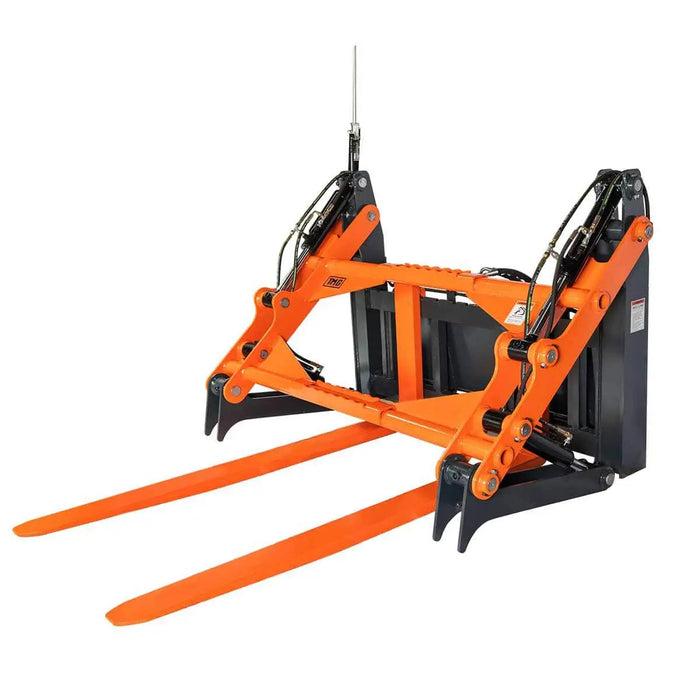
Four separate cylinders change the arrangement. Each section of the jaw stops when it meets something and the remaining sections keep closing, so the clamp conforms to the shape of the pile rather than to its single highest point. A pallet fork grapple built this way ends up holding the load at several places instead of pinching it at one.
Pressure that shares itself holds better
There is a second effect that matters more than it sounds. Grip comes from friction, and friction follows the force pressed into each contact point. Spreading the same hydraulic force over four contacts gives four useful points of friction instead of one hard point and three that do nothing at all.
That is also what protects the material. Thin wall pipe, conduit and finished posts crush at the single place where all the force lands, and a pallet fork grapple that shares its pressure can hold them firmly without leaving a flattened spot behind.
Why this is not simply a smaller version of a log grapple
A skid steer grapple meant for logs has curved tines designed to bite into bark and roll a trunk upward. Pipe and finished stock need the opposite: flat contact, even pressure, and no penetration at all. The jaw shape follows from what the load tolerates, not from how heavy it is.
That difference shows up in the forks underneath as well. Keeping the pallet forks means the same attachment still handles crates and banded bundles between pipe jobs, which is usually why it earns a place on a small yard where one carrier does everything.
Where the load sits changes what the jaw has to do
A bundle carried close to the carriage puts most of its weight through the forks, and the jaw only has to stop it rolling. Push the same bundle out to the tips and the jaw starts carrying real load, because the pile wants to pivot around the front of the forks. That is the moment four cylinders earn their cost, and it is also the moment the loader behind them starts feeling light at the rear.
What to check before fitting one
Three things decide whether a pallet fork grapple suits your machine:
- Auxiliary flow: enough to close under load
- Mount class: ITA Class III matches the carriage
- Jaw opening: wider than the tallest bundle expected
TMG Industrial builds this one on a sixty inch frame rated to 6,200 pounds of lift, with four cylinders across the jaw. The number on any grapple attachment describes the attachment itself, so the figure that actually limits a job is still whatever your own loader can hold out in front of itself without getting light at the back.