Renovation work can make a building temporarily vulnerable long before the finished design is in place. Removing a wall, altering a column, repairing a foundation, or excavating near an existing structure can change how loads travel through the building. Experienced earth shoring contractors help create a controlled support plan for these transition stages.
Temporary shoring is not a substitute for permanent structural design. It is a planned system that supports vertical or lateral loads during demolition, repairs, excavation, or new construction. The goal is to keep the structure stable until the permanent walls, beams, columns, slabs, or foundations can safely perform their intended role.
1. Why Temporary Shoring Matters
A building may be stable in its original condition but require temporary support during construction. For example, opening a load-bearing wall for a larger kitchen, storefront, or doorway can interrupt the path that transfers floor and roof loads downward. Temporary posts and beams can carry those loads while the new permanent beam and its supporting details are installed.
Shoring also matters when work affects adjacent property. Excavation near a footing, demolition beside an occupied building, or foundation repair below an existing wall can introduce movement that was not present before construction began. A qualified engineer should determine the temporary condition and the sequence needed to manage it safely.
2. How Shoring Works
Shoring uses temporary members to support, brace, or restrain a building element, excavation, or nearby structure. In simple terms, it establishes an alternate route for forces while permanent work is incomplete. The broader category of shoring systems includes vertical, angled, and horizontal arrangements used for buildings and excavations.
Following The Load Path
- A wall, floor, beam, or façade transfers load to a temporary beam, frame, post, or brace.
- The temporary member delivers that force to base plates, cribbing, grillage, or another designed bearing point.
- The reaction moves into a stable slab, footing, foundation, or competent soil.
- The system stays braced and properly supported until the permanent load path is complete.
The bearing surface deserves as much attention as the shore itself. A strong steel post can still create a hazardous condition if it concentrates force onto a slab, floor, or soil area that cannot safely resist it.
3. Common Shoring Systems
- Post and beam shoring: Temporary posts and beams used to support floors, localized openings, and interior framing.
- Needle beam shoring: Beams installed through or beneath a wall to transfer wall loads to temporary supports.
- Raking shores: Angled braces that provide lateral support for a wall or façade showing instability.
- Steel shoring frames: Adjustable, high-capacity systems that can preserve more working room beneath supported areas.
- Hydraulic jacks: Equipment used for controlled loading, adjustment, or load sharing at multiple support points.
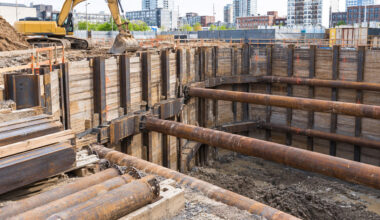
- Excavation shoring: Systems that retain soil and help protect workers, utilities, pavements, and neighboring foundations during below-grade work.
4. When Shoring Is Needed
Project conditions that may warrant a shoring evaluation include removing load-bearing walls or columns, creating large openings, replacing damaged structural members, lowering a basement, repairing foundations, installing heavy rooftop equipment, or excavating near existing footings. Cracks, settlement, leaning walls, and water-related damage are also reasons to pause and obtain qualified advice, rather than assuming the cause or level of risk.
5. The Planning Process
A careful plan treats the temporary condition as a design phase rather than an on-site improvisation. The process commonly includes:
- Reviewing drawings, repair records, and prior alterations.
- Inspecting framing, foundations, cracks, corrosion, water damage, and access constraints.
- Mapping loads at every stage, including demolition and installation of permanent work.
- Reviewing soil, groundwater, utilities, nearby buildings, and excavation depth.
- Preparing installation, inspection, adjustment, and removal procedures.
- Coordinating the sequence among the owner, engineer, contractor, and site crew.
Field changes should not be made casually. Moving a shore, changing a demolition order, or adding equipment can alter loads and reactions not included in the original plan.
6. Site Monitoring And Inspections
Monitoring turns a shoring plan into an active safety process. Depending on the work, teams may use crack gauges, survey points, settlement markers, inclinometers, vibration monitors, load cells, and visual inspection logs. Inspections are especially important before installation, while supports are loaded, after major work changes, and before removal.
For excavation work, OSHA requires support systems when adjoining structures are endangered and requires competent-person inspections when employee exposure is anticipated. The agency’s requirements for adjacent structural stability also address excavation below nearby footings and the protection of those footings from hazardous conditions.
Stop-work triggers can include sudden cracking, unexpected movement, shifting base plates, damaged braces, uneven bearing, water intrusion, or leaking hydraulic equipment. These conditions require prompt evaluation before work resumes.
7. Common Planning Mistakes
- Beginning demolition before temporary support is fully installed and checked.
- Assuming an existing slab can carry concentrated shore reactions.
- Ignoring hidden utilities, voids, weak soil, or groundwater.
- Using damaged, mismatched, bent, or corroded components.
- Changing the work sequence without engineering review.
- Removing shores before the permanent system can carry the intended loads.
A July 2026 Midtown Manhattan incident illustrates why temporary support and measured assessment matter. After columns buckled and floors sagged during a conversion project, crews performed emergency stabilization work while officials monitored the building and engineers evaluated repairs. Temporary shoring can help control the condition, but it does not eliminate the need for a thorough structural investigation.
8. Questions To Ask Before Work Begins
- What loads will the temporary system carry, and where will they be transferred?
- Can the receiving slab, footing, or soil safely carry concentrated reactions?
- Who may approve field changes to the support plan?
- What movement, vibration, or settlement limits apply?
- How often will inspections occur, and what records will be kept?
- What conditions require an immediate work stoppage?
- When and under what criteria can the shoring be adjusted or removed?
9. Final Thoughts
Temporary shoring is a deliberate part of safe renovation and excavation work. Effective systems rely on engineering, sound materials, stable bearing points, careful installation, clear communication, and consistent monitoring. When every stage has a defined load path, project teams can complete structural changes with better control and fewer avoidable surprises.