Most siding gets replaced two to four years later than it should, and I’ve walked enough properties to know the pattern. The homeowner wasn’t lazy. They just didn’t know which signals meant “watch this” and which meant “call someone this week.”
Here’s the good news: you can figure out most of it yourself in about thirty minutes with a notebook and a pair of binoculars. This guide covers the six warning signs that actually matter, the materials worth considering in a climate that swings from humid Augusts to single-digit Januaries, and how to tell repair from replacement without guessing. If you’d rather have trained eyes on it, roofers who handle siding services in North Jersey can inspect and quote it, but read this first so you know what you’re looking at and what questions to ask.
One thing before we start. North Jersey is genuinely harder on siding than most of the country. You get freeze-thaw cycles that open up tiny gaps, nor’easters that drive rain sideways, and summer humidity that refuses to leave. That combination punishes every material differently.
Why North Jersey Wears Siding Differently
Water is the enemy, not age. Siding that stays dry can outlive its warranty by a decade. Siding that stays damp starts failing from the inside, which is why the outward appearance lags behind the real damage by a year or two. That lag is the trap.
The freeze-thaw piece matters more than people realize. Water seeps into a hairline crack, freezes, expands, and widens that crack. Then it thaws and does it again. According to the National Weather Service, freeze-thaw swings are a routine part of the winter pattern across the northern part of the state, which means your siding is getting mechanically worked over every single season. Vinyl gets brittle in the cold and can crack on impact. Wood absorbs and releases moisture, which is why it needs repainting more often up here than the label suggests.
I’d rather see a homeowner spend an afternoon understanding this than spend twenty minutes picking a color. Color is the fun part and it’s also the cheapest thing to change later.
The Six Signals That Actually Matter
Ignore the cosmetic stuff for now. These are the ones worth writing down.
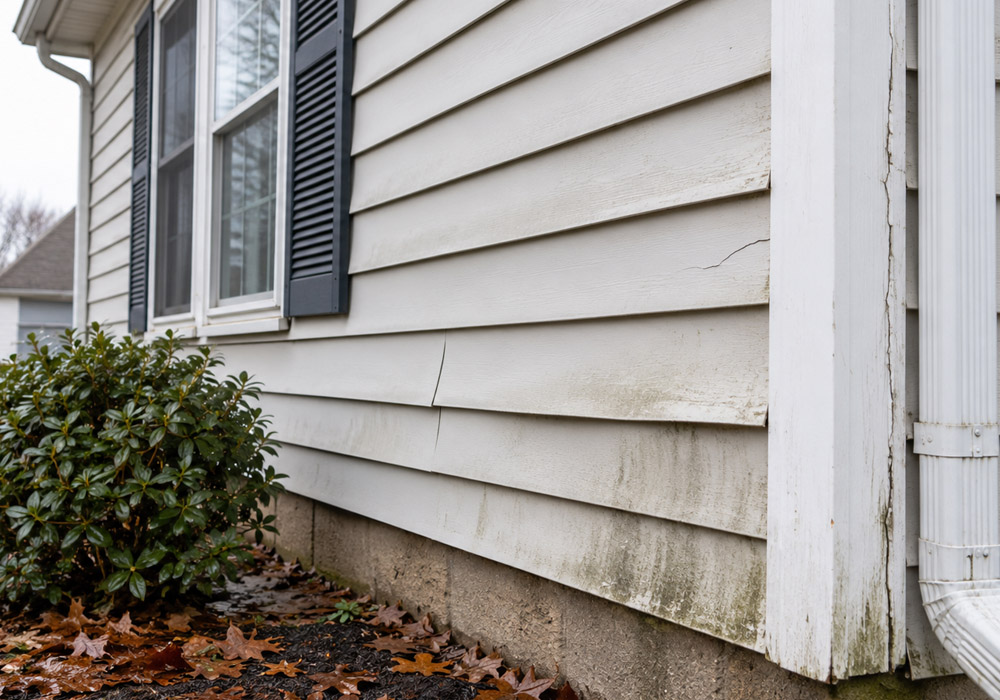
- Soft spots. Press with a screwdriver handle, not the tip. If the siding gives, water is already behind it.
- Bubbling or peeling paint. Paint fails when moisture is pushing out from underneath, not when it’s worn from sun.
- Warping or bowing. Panels that ripple in the middle have taken on water or were nailed too tight.
- Gaps at seams and corners. Caulk fails first at joints. Check every corner trim and window edge.
- Crumbling or chalky texture. If it wipes off on your hand like powder, the material is breaking down.
- Rust streaks or green staining. That’s water finding a path, and it usually starts above where you see the stain.
Sort these into two buckets. Soft spots, gaps, and bubbling point toward moisture getting in. Warping, chalking, and staining point toward material fatigue. The first bucket is more urgent because it usually means the sheathing behind the siding is wet.
What’s Hiding Behind the Panels
Wet sheathing is the expensive part of this story, and it’s the reason a “small repair” sometimes turns into a bigger job. Siding is a rain screen. It sheds most water, but the house wrap and flashing behind it do the real sealing. When those fail, the wood framing takes the hit.
Mold, rot, and softened structural panels don’t announce themselves. You find them when a panel comes off. This is why I’d tell any homeowner to get a moisture reading before signing off on a patch job. If the substrate is dry, patch away. If it’s damp, patching just hides a problem that grows.
The U.S. Department of Housing and Urban Development publishes homeowner resources on moisture control and home maintenance through HUD, and it’s worth a look if you want a plain-language primer on how water damage develops inside walls. Cheap reading, expensive lesson if you skip it.
Choosing Material for a Four-Season Climate
Here’s where I’ll take a side. For most North Jersey homes, fiber cement is the best balance of durability and appearance, and vinyl is the best balance of cost and low maintenance. Wood looks the best and costs the most in upkeep. Metal is underrated for south- and west-facing walls that bake all afternoon.
| Material | Typical Lifespan | Maintenance Reality | Best Fit
|
| Composite | 20 to 30 years | Low, resists moisture and insects | Humid, shaded walls |
| Fiber cement | Up to 50 years | Low to moderate, repaint on a long cycle | Whole-house replacement |
| Vinyl | 20 to 40 years | Very low, wash it occasionally | Budget-conscious projects |
| Wood | Varies widely | High, recoat every 5 to 10 years | Historic and custom homes |
| Metal | 30 to 50 years | Low, dents more than it decays | Sun-exposed walls |
Don’t pick a material off that table alone. Pick it against which side of your house fails first. A wall under a tree canopy that never dries needs a different answer than a wall in full afternoon sun.
While you’re at it, think about air sealing and attic ventilation, because both affect how much moisture your walls hold. The Department of Energy explains how insulation and air sealing work together through Energy.gov, and it’s the same system your siding is protecting. Fix the ventilation and your new siding lasts longer.
Repair or Replace: A Decision Walkthrough
Run this in order. It takes about ten minutes once you’ve done your walk-around.
- Count damaged panels. Under ten, spread out, on one or two walls? Repair is usually the right call.
- Check the pattern. Damage clustered on one elevation signals a specific leak or a failing wall. Damage everywhere signals material end of life.
- Test for moisture. Soft spots or bubbling anywhere means you need the substrate checked before anything else.
- Price both. If a repair runs past roughly a third of replacement cost and the siding is over fifteen years old, replace.
- Match the material. Repairing one wall of discontinued siding rarely works. You’ll see the seam from the street.
Here’s a concrete example from a job I watched play out. A homeowner in a 1960s split-level had three cracked vinyl panels on the shaded north wall. Cheap fix, right? The moisture reading said otherwise. The house wrap behind those panels had failed, and two courses of sheathing were soft. That turned a few-hundred-dollar patch into a partial re-side. The cracked panels were the messenger, not the message.
Questions to Ask Before Anyone Touches Your House
Get answers in writing, not from the driveway.
- Will you pull the permit, and is it included in the number?
- What’s the workmanship warranty length, and does it transfer if I sell?
- Are you removing the old siding or going over it, and why?
- How will you handle flashing at windows and doors?
- What happens if you find rot once the wall is open?
That last one separates the pros. A contractor who has a written answer for hidden damage isn’t guessing, and they’ve probably seen it a hundred times.
None of this is complicated, which is sort of the point. Siding fails slowly, announces itself quietly, and gives you time to make a good decision. Use the time. Do the walk-around this weekend, write down what you find, and compare it against the six signals above. Then decide.
If you’d rather have someone confirm what you found, book an inspection and ask them to show you the photos. Any contractor worth hiring will.