Most product demos lose 60 percent of their viewers before the halfway mark. Not because the product is dull. Because the frame is. A white wall, a laptop, a hand clicking through screens, and nobody moves, nobody touches anything, nothing breathes. The camera has nowhere to go, so the viewer’s attention goes instead. The fix is often cheaper than people expect, and it starts before you hire anyone.
Location changes what the product means. A portable generator shot on a studio table is a rectangle with a handle. The same generator, shot at dusk on a tailgate while a family scrambles eggs on a camp stove, is a way to skip the hotel. Same object. Two different arguments. That is the shift worth planning for, and it’s a big part of why a video production company in utah will usually push clients toward real environments over rented studio space. The geography does half the work.
So before you book a stage, ask what room your product actually lives in. Then put a camera in it. Here’s how the whole thing works, from the scout to the final cut, without wasting a shoot day.
Why does a plain background kill a demo?
Because the viewer’s brain has nothing to hold onto except the thing you’re selling, and that reads as a commercial the second it starts. Context is what turns attention into interest. Someone using your product in their own kitchen feels like information. Someone using it in a void feels like an ad.
There’s a practical reason too. Location gives the camera something to do. A slow push down a hallway, a hand reaching past a doorframe, a product sitting on a shelf with clutter around it. Those moves give the editor options. A studio demo gives an editor one option: cut back to the laptop.
Pick the location the way a scout would, not the way a landlord would
I’ve watched brands lock in a beautiful loft because it looked good in photos and then discover the floor bounced under every footstep and the windows faced a construction site. Nothing salvageable. My rule: judge a location for sound and light first, appearance last. You can fix ugly. You cannot fix a jackhammer.
- Windows: does sun land on the hero product at any point during your shoot window?
- Noise floor: stand still for two minutes and just listen. Traffic, HVAC, a refrigerator hum, a neighbor’s dog.
- Power and parking: where do the gear and the crew physically go, and how far is the walk?
- Permission: who signs, and do they understand you’ll need a window of hours, not minutes?
- A second room: you want at least two distinct spaces so the edit has somewhere to cut to.
Scout at the same time of day you’ll shoot. Morning light and afternoon light behave like different locations entirely, and that single habit saves more reshoots than any gear upgrade.
Build a shot list around tasks, not features
This is where most shoot days go sideways. The client arrives with a feature list and the director has to translate it live. Do that translation beforehand. For every feature you plan to mention, write down one human task that proves it exists.
| What the product does | What the camera actually films |
|---|---|
| Weatherproof housing | Hands hosing it down in a driveway, water sheeting off |
| Fast setup | One continuous take, box to fully assembled, no cuts |
| Long battery life | Same unit running at sunrise and again at golden hour |
| Easy sharing | Two people passing it back and forth without instructions |
Notice the column on the right never says “demonstrate.” It describes something a person does. That distinction is the whole job. If your shot list reads like a spec sheet, your video will too. This is also where the best production teams earn their fee, because they’ll argue with you about a shot before the day starts rather than after.
The room tone confession
I once cut a location interview where the hero shot was perfect, the lighting was perfect, and the audio was ruined by an ice machine two floors down that nobody noticed until the mix. We spent a full day in post trying to save it. The fix at the time of the shoot would have taken four minutes: record thirty seconds of silence in every room with the crew holding still, and get a clean room tone.
That’s not a technical nicety, it’s insurance. Editors use room tone to hide every cut in a conversation. Without it, you hear the seams. With it, the dialogue flows like one continuous thought even though it was stitched from six different takes. If you only remember one thing from this article, remember that one.
Light the place you found, don’t replace it
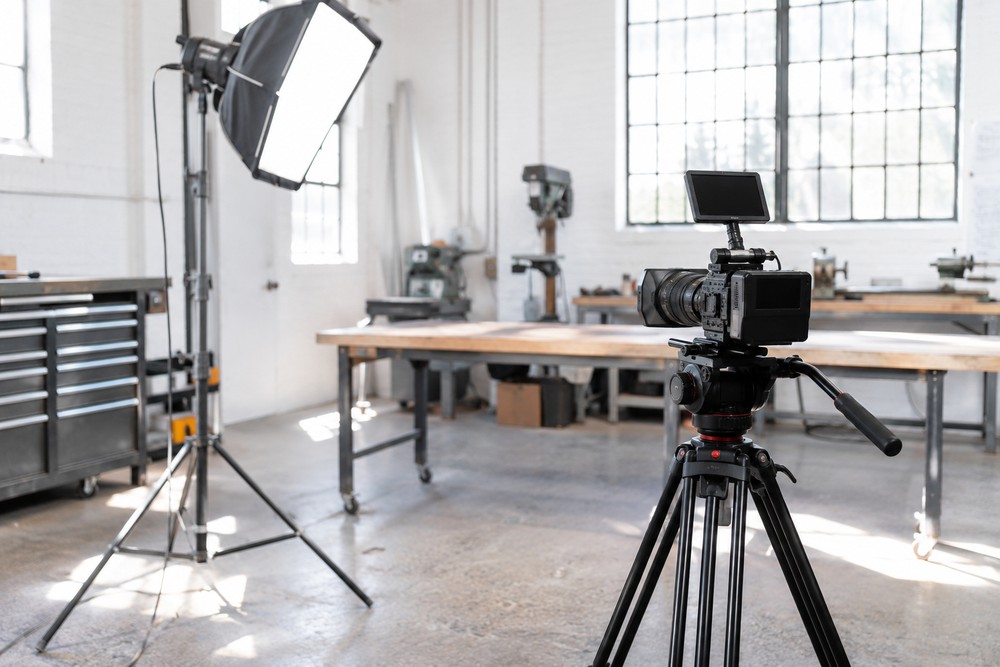
Good location work looks like the location. That’s the tell that separates a real shoot from a stage dressed up to resemble an office. If you walk into a workshop with dusty light coming through a high window, you keep the dust. Your lighting kit shapes what’s already there rather than pretending it’s noon everywhere.
The conservation and archival world figured this out long ago. The Library of Congress preserves original recordings and documents specifically because the artifact carries meaning the recreation loses. A copy of a room is not the room. The same logic applies when your audience can feel that a set was built. Something in them disengages.
Practically, that means fewer lights and more patience. Wait for the sun to hit the right angle. Bounce it into the shadow side of a face instead of blasting a softbox at it. Block the ugly window with a flag and let the good one do the work. Slower on the day, faster in the edit, and better on the screen.
A concrete scenario worth copying
A regional equipment brand wanted a demo of a small trailer. The obvious version was a turntable shot in a warehouse. Instead the crew spent a morning at a trailhead forty minutes from Salt Lake City, filming a guy backing it into a tight spot, hitching it, and driving off with dust coming off the tires. No voiceover. No bullet points. Just tasks, done under real conditions, in sequence.
What made it work wasn’t the scenery, it was the friction. The hitch that took two tries. The driver squinting at the mirror. Those small troubles read as honest, and honest reads as believable. A polished studio version of that same trailer would have been forgettable in ten seconds.
Where the weather and the gear meet
Outdoor locations ask more of your equipment than a stage does, and that’s not a reason to avoid them, it’s a reason to plan. Camera bodies and lenses get rated for operating temperature and humidity, and those ratings exist for exactly this situation. The National Aeronautics and Space Administration publishes environmental extremes for its own instruments because hardware behaves differently when the conditions change, and consumer and pro camera gear follows the same principle at a smaller scale. Check the spec sheet before you commit to a desert shoot in July.
Cold drains batteries faster than anything else. Heat softens adhesives and fogs lenses when you move from a cool car into humid air. Bring twice the batteries you think you need, let lenses acclimate before you roll, and keep a dry bag in the kit. Boring preparation, unglamorous results, finished video.
Measure the work against a standard, not a mood
When the first cut lands, everyone has an opinion and nobody has a ruler. Borrow one. The National Institute of Standards and Technology exists around the idea that shared measurement is what lets people trust a result, and your review process deserves the same discipline. Decide in advance what “done” looks like: does the task read clearly at normal speed, can a stranger explain the product after one viewing, does the opening five seconds show a human doing something?
Those are testable. “It feels flat” is not. Write your three criteria down before the edit starts and you’ll cut the review cycle in half.
One shoot day, one decision
The most common mistake isn’t technical. It’s shooting a demo in a room the product never enters, then trying to fix the flatness in post with music and motion graphics. That almost never works. If you take one thing from all of this, take the location. It’s the cheapest story upgrade available, and it beats every filter in the editing suite.
So go look at the rooms your product actually lives in this week. Which one would make someone stop scrolling? Sketch it, scout it at the right hour, and build your shot list around tasks. If you’d rather hand that to people who do it every week, the crews in Salt Lake City are worth a conversation. What’s the one room your product belongs in that you’ve never filmed?