In Lake St. Louis, Missouri, window treatments need to do more than complement a room’s colors. Bright summer afternoons, changing seasonal light, nearby homes, and busy family routines can all affect what works best. Whether you are updating a single room or evaluating window blinds repair Lake St. Louis, MO, start by identifying what each window needs to accomplish every day.
The strongest choice is rarely the most expensive or decorative option. A treatment should fit the room’s purpose, control the light that enters it, provide appropriate privacy, and remain easy to use. Planning room by room helps Lake St. Louis households create spaces that feel calmer, more comfortable, and more practical in every season.
Start With the Room’s Main Job
A bedroom, kitchen, home office, and family room do not ask the same things from a window covering. Bedrooms usually benefit from stronger privacy and room-darkening capability. Living rooms may need daylight without television glare. Offices need screen-friendly light, and kitchens need materials that tolerate cooking residue, heat, and regular cleaning.
Think about how people use the room from morning through evening. A street-facing first-floor room near Lake St. Louis Boulevard may need more privacy than an upstairs study, while a sun-filled breakfast area may call for a treatment that softens glare without closing off the view.
If existing slats will not tilt smoothly, cords are worn, or a shade will not raise evenly, searching for window blinds repair near me can be a sensible first step before replacing every treatment in the home.
Study Light Throughout the Day
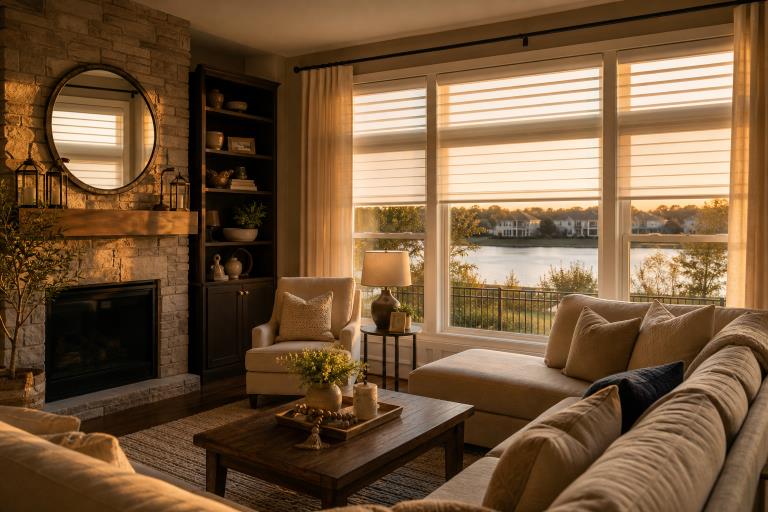
Observe each room several times before choosing opacity, color, or fabric. Morning sun may be welcome in a kitchen, but afternoon sunlight can make a west-facing family room uncomfortably bright. Consider whether glare affects a television, computer monitor, artwork, or dining table.
Windows affect daylight, solar heat, and overall indoor comfort, which is why daylighting and shading are important considerations when planning a window-treatment update. The goal is not to eliminate natural light, but to direct and soften it in a way that suits the room.
Match Privacy to Window Location
Privacy changes with the window’s location, nearby sightlines, and time of day. Light-filtering shades can provide daytime privacy while maintaining a bright feel, but they may show silhouettes after dark when interior lights are on. Bedrooms, bathrooms, nurseries, and front-facing rooms often need more complete coverage.
- Use room-darkening shades or lined drapery where sleep and nighttime privacy matter most.
- Consider top-down and bottom-up window designs for rooms that need privacy at eye level but still benefit from upper daylight.
- Layer blinds or shades with drapery when one room needs multiple light and privacy settings.
Choose the Right Treatment Type
Roller Shades
Roller shades have a clean profile and are available in sheer, light-filtering, solar-control, and room-darkening materials. They are often a practical option for offices, living rooms, and bedrooms where straightforward operation matters.
Cellular Shades
Cellular shades use a layered, honeycomb-like construction that can create a softer appearance and add an insulating layer at the window. They are worth considering in bedrooms, draft-prone rooms, and spaces where comfort is a higher priority.
Wood, Faux Wood, and Shutters
Adjustable slats and louvers make it easier to redirect light rather than block it completely. Faux wood can be especially useful in kitchens, bathrooms, and high-traffic areas because it is generally durable and easy to wipe clean. Shutters provide a more structured look with strong privacy control.
Roman Shades and Drapery
Fabric treatments add softness, color, and texture. Roman shades can give a tailored finish, while drapery can make larger windows feel more finished. Lining, fullness, and layering all influence how much light and privacy the final treatment provides.
Consider Temperature and Energy Comfort
Window coverings cannot replace efficient windows, weatherstripping, or insulation. Still, they can help manage direct sun, drafts, and uneven room temperatures. Solar-control shades are useful where late-day sun creates glare, while lined drapery and cellular designs may help rooms feel less exposed during cooler Missouri weather.
Lighter colors can reflect more sunlight and keep a room visually open. Darker fabrics may create a dramatic look, but they can make a small or shaded room feel heavier. Request samples and view them against the actual wall color in daylight and at night.
Use Smart Features Purposefully
Motorized or smart treatments are most useful when they solve a real access or routine problem. They can be helpful for tall windows, windows over stairways, large groups of shades, or rooms where direct sun arrives at the same time every day. Before choosing automation, ask about battery access, charging, manual controls, noise level, and compatibility with the household’s existing smart-home setup.
Plan for Safety and Easy Operation
Safety belongs at the center of the selection process, especially in homes with young children, pets, or frequent family visitors. The safest option when young children are present is to go cordless. Keep cribs, beds, climbing furniture, and toys away from cords, and inspect older coverings for damaged parts or accessible loops.
Measure Before You Order
- Measure width and height in more than one place because window openings are not always perfectly square.
- Decide whether the treatment will mount inside the frame or outside it.
- Check for handles, locks, trim, vents, doors, and furniture that could interfere with operation.
- Test samples in the actual room during bright and dim conditions.
- Confirm cleaning requirements, warranty details, and how the treatment will open and close.
Avoid Common Mistakes
- Using the same treatment in every room without considering moisture, glare, or privacy needs.
- Choosing from a small online image instead of reviewing a material sample.
- Ignoring seasonal sunlight and afternoon glare.
- Forgetting about window handles, patio doors, and nearby furniture.
- Prioritizing appearance while overlooking safety and daily operation.
Common Questions
Should every room have the same window treatment?
Not necessarily. A shared color palette can create visual flow, but each room may need a different level of privacy, darkness, moisture resistance, or glare control.
Are blackout treatments only for bedrooms?
No. They can also be helpful in nurseries, guest rooms, media spaces, and any room where sunlight interferes with rest or screen viewing.
What works best in a home office?
Start with glare control, camera-friendly daylight, privacy, and easy adjustment. A light-filtering or solar-control shade often gives more flexibility than a heavy treatment that leaves the room too dim.
Final Thoughts
The best window treatments for a Lake St. Louis home make everyday routines easier. By evaluating light, privacy, comfort, safety, and operation one room at a time, homeowners can choose coverings that look appropriate while supporting the way their homes are actually lived in.