Including the one trick that saves you money at the register and quietly costs you more by December.
Last checked September 2026. Every dollar figure below was read on medicare.gov, ssa.gov, cms.gov or the organization’s own site in September 2026.
The pharmacist turns the monitor toward you and it says $412.80. Same insurance you had in July. Nothing changed, except the plan moved your drug to a different tier, or you hit the deductible. You say you will come back for it, which you both know means you will not.
Or it is your father, and you find out in October that he has been splitting a 30-day supply across six weeks since spring. He did not mention it because he did not want to be a problem. He is taking two thirds of a dose a cardiologist picked for a reason.
Real money exists for this, in five places, run out of agencies that do not talk to each other: Social Security, your state, your drug plan, a charity, the drug company. Each has its own form, and the most popular option, the discount card, quietly works against one of the others. Seven routes below, in no particular order. Entry one is a paid service, first only because the list starts somewhere.
The single number that decides which of these is worth your time
Medicare.gov says that in 2026, once out-of-pocket spending on covered Part D drugs reaches $2,100, “you’ll pay $0 for each covered drug” for the rest of the year. No plan may have a deductible above $615. That ceiling changes the question from “what does this cost” to “does this payment move me toward it.”
- Your own payments through the plan count toward the $2,100.
- Extra Help paid on your behalf counts, per Medicare.gov.
- State Pharmaceutical Assistance Program payments count. CMS says so in writing.
- Discount cards do not count. Medicare.gov is explicit.
- Manufacturer assistance outside the Part D benefit does not count, per CMS.
- The payment plan changes when you pay, not how much.
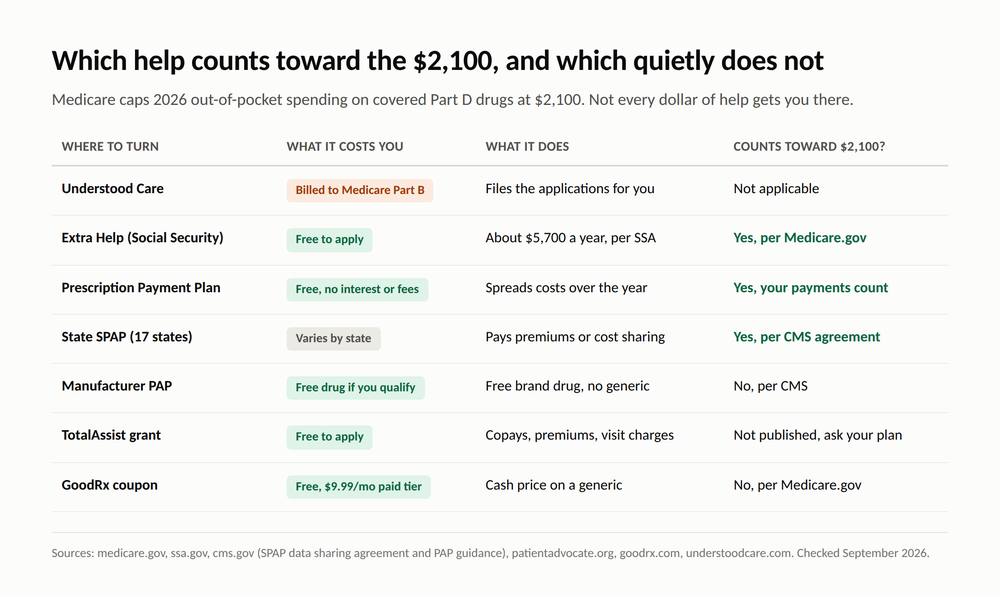
Which help counts toward the $2,100, and which quietly does not
Understood Care
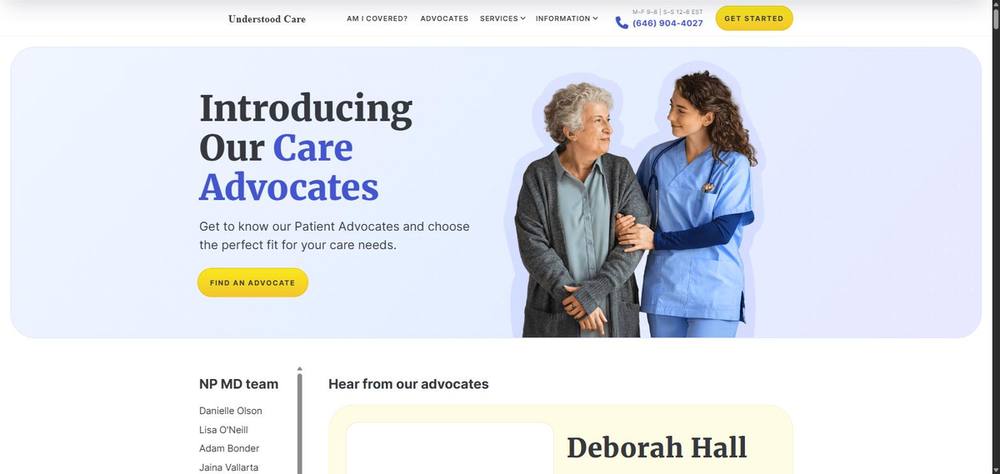
A virtual advocacy service whose FAQ says care is “completely virtual” through “phone and video calls,” across the US, M–F 9–8 and S–S 12–8 EST on (646) 904-4027. The site lists six physicians and nurse practitioners plus more than thirty advocates, one focus area being medication access. On prescriptions the FAQ says advocates help “lower medication costs,” meaning somebody else fills out the forms.
Billing is the unusual part. It bills Medicare under “Medicare Community Health Integration Services” and “Principal Illness Navigation Services” rather than charging a retainer, and says it is “covered by Medicare for most patients (Medicare Part B).” It also publishes a roundup of patient advocate services for seniors on Advantage plans. Family can refer on (646) 396-0527.
Key strengths
- Billed through Part B for most patients, not as a subscription.
- Open until 8 p.m. EST on weekdays and on weekends.
- One team handles the Extra Help, manufacturer and foundation forms together.
Best for
Someone facing five applications who will realistically finish none alone.
Worth asking about
“Covered by Medicare” is narrower than it sounds. The pricing page conditions coverage on having “Original Medicare and a supplemental plan and have paid your deductible,” and the FAQ says advocacy is “not yet covered by Medicaid” or commercial insurance. Without a supplement, no price is published anywhere on the site.
Extra Help through Social Security
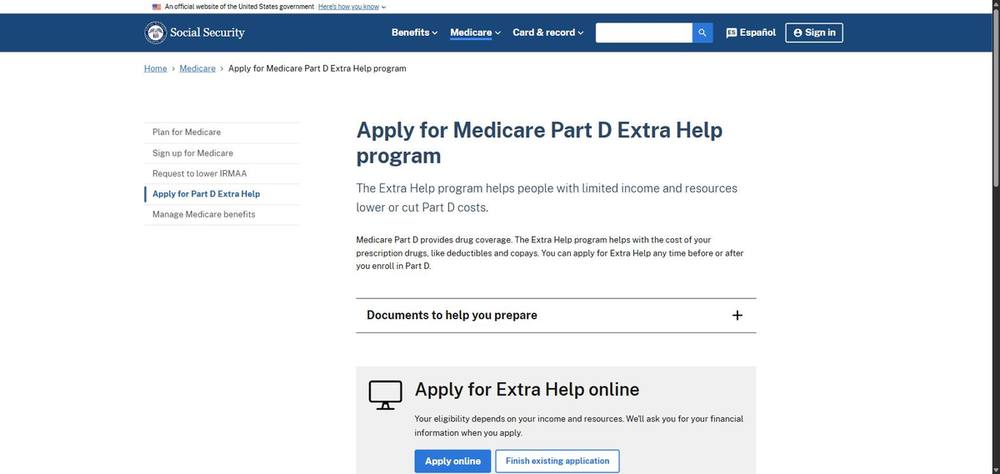
The biggest single lever, and the most under-claimed. Social Security’s August 2026 publication puts the value at “about $5,700 per year.” CMS set 2026 cost sharing for people who qualify at a $0 deductible and either $1.60 generic and $4.90 brand, or $5.10 and $12.65.
SSA’s 2026 limits: annual income of $23,940 for a person or $32,460 for a married couple, resources of $18,090 or $36,100. Your primary residence and your vehicles do not count. Medicare’s fact sheet says you get Extra Help automatically with full Medicaid, state help paying Part B premiums, or SSI. Apply at ssa.gov or 1-800-772-1213, any time.
Key strengths
- Worth roughly $5,700 a year, per SSA’s own estimate.
- The house and the cars are excluded from the resource test.
- Payments made on your behalf count toward the $2,100 cap.
Best for
Anyone near those limits, including people who assume they earn too much.
Worth asking about
The limits are hard cutoffs. Someone a few hundred dollars over gets nothing, because there is no partial award above the line. The form asks about resources, which is the part that stops people.
Medicare Prescription Payment Plan
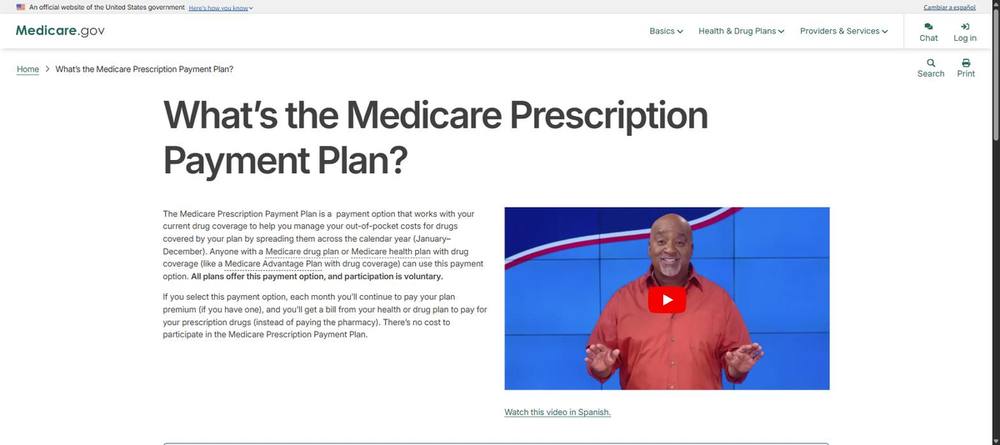
The most misunderstood option here, because people hear “payment plan” and expect a discount. Medicare.gov says it plainly: this “doesn’t save you money or lower your drug costs.” It spreads out-of-pocket costs across the calendar year, so a $600 January need not be paid in January.
The terms beat most consumer credit. “There’s no cost to participate,” and per Medicare’s fact sheet, “you won’t pay any interest or fees, even if your payment is late.” Anyone with a Part D or Advantage drug plan can use it. Contact your plan to start “anytime during the calendar year.”
Key strengths
- No interest and no fees, even on a late payment.
- Open to any Part D or Advantage drug plan member, no income test.
- Turns one impossible month into twelve manageable ones.
Best for
A big, front-loaded drug bill on a fixed monthly income.
Worth asking about
Timing decides whether this helps at all. Medicare says it works best if you join “before September” and your costs come early in the year, and that you probably will not benefit if you already get help with drug costs.
State Pharmaceutical Assistance Programs
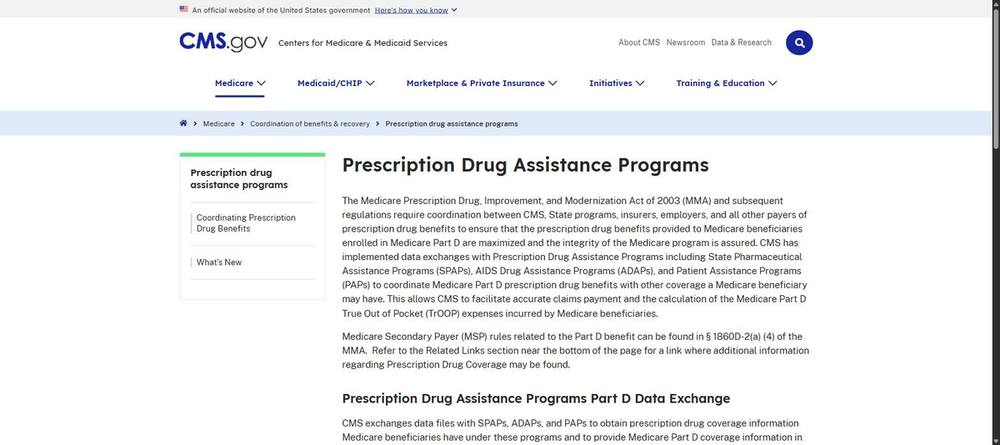
A minority of states run drug programs that sit on top of Part D. Medicare.gov describes them as providing “coverage from your state (or the U.S. Virgin Islands) to help pay your drug plan premiums and/or cost sharing.” Why they beat a coupon: CMS’s data sharing agreement says an SPAP’s payments on your behalf “will be considered incurred costs by the Part D beneficiary and will therefore count toward the beneficiary’s TrOOP.”
CMS publishes a contact list naming seventeen: Connecticut, Delaware, Illinois, Indiana, Maine, Maryland, Massachusetts, Missouri, Nevada, New York, New Jersey, North Carolina, Pennsylvania, Rhode Island, Texas, Vermont and Wyoming. New York’s EPIC shows the shape: 65 and up, a resident, enrolled in or eligible for Part D, income up to $23,000 single or $29,000 married, applications any time with “no documentation required.”
Key strengths
- The state’s payments count toward your federal out-of-pocket cap.
- Income limits are often more generous than Extra Help’s.
- Some, like EPIC, take applications year round with no paperwork.
Best for
People in those seventeen states whose income sits just above the Extra Help line.
Worth asking about
Most of the country has no SPAP, and nothing you do changes that. Rules and covered drug lists are set state by state, and CMS puts no revision date on its contact list, so confirm the program still has funding.
RxAssist and manufacturer patient assistance programs
Drug companies run their own giveaway programs. CMS puts it accurately: manufacturers “may sponsor patient assistance programs (PAPs) that provide financial assistance or drug free product (through in-kind product donations) to low income individuals.” For an expensive brand drug with no generic, this is often the only route to zero.
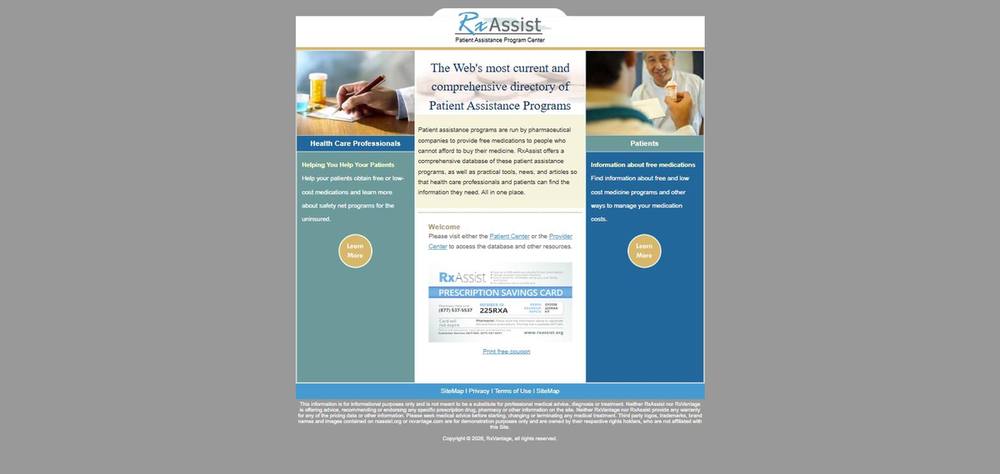
Finding them is the hard part, which is what RxAssist is for: a free directory with “current application forms and information,” searchable by drug or company, operated by RxVantage and carrying a 2026 copyright.
Key strengths
- Free to search, with the actual application forms attached.
- Searchable by drug or by manufacturer, which is how you think.
- For a single expensive brand drug, it can take the cost to zero.
Best for
One specific brand-name drug that is driving the entire bill.
Worth asking about
Here is the catch, the same shape as the discount card catch below. CMS states that for a PAP operating outside the Part D benefit, “the PAP’s assistance on behalf of the PAP enrollee does not count towards a Part D beneficiary’s true-out-of-pocket cost (TrOOP).” The drug is free, and none of its value carries you toward $2,100.
Patient Advocate Foundation and TotalAssist
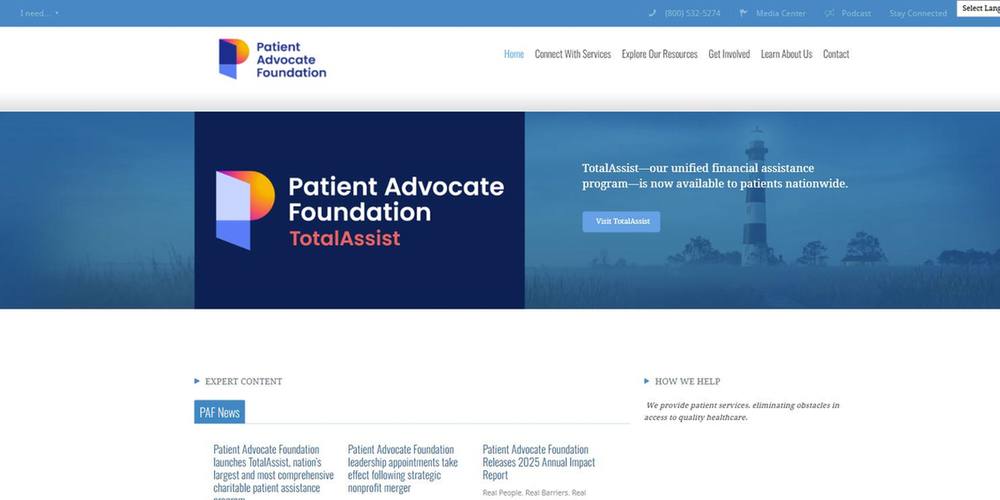
Patient Advocate Foundation calls itself “a national 501 (c)(3) non-profit organization which provides case management services and financial aid to Americans with chronic, life threatening and debilitating illnesses.” It merged with the PAN Foundation in 2026, and the combined program, TotalAssist, opened July 1, 2026. That matters if you are working from older advice, because PAN’s funds now sit inside it.
TotalAssist runs “nearly 150 disease-specific, health equity, and non-disease support services funds” covering “medication, copays, coinsurance, and deductibles,” premiums and same-day office visit charges, and says it is “designed to cover 100% of out-of-pocket costs for most patients.” You need income “at or below the indicated level of the Federal Poverty Level. (500% or less for most funds)” and “the specified health insurance that covers qualifying expenses.” Apply on 866-512-3861.
Key strengths
- Income ceiling of 500% of the federal poverty level for most funds.
- A six-month lookback, so money already spent may be reimbursable.
- Covers premiums and office visit charges, not just the drug.
Best for
A named serious or chronic diagnosis, with insurance already in place.
Worth asking about
Funds are diagnosis-specific and finite, so the first question is whether your condition has one and whether it is open today. You must already hold insurance covering the expense, so this is no fallback for the uninsured. The site does not say how a grant counts against your Part D total.
GoodRx and other discount cards
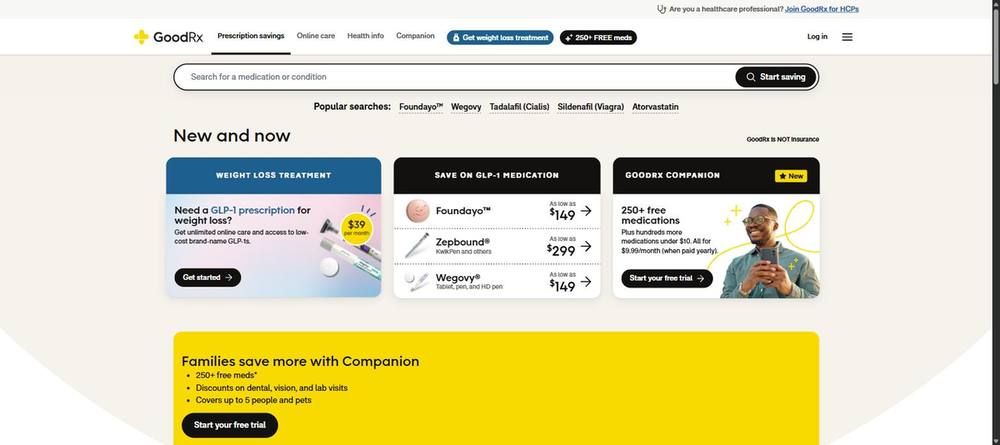
GoodRx states on its own homepage that it “is NOT insurance.” It is a price comparison and coupon tool, free to use, advertising savings “up to 80%,” with an optional paid tier at $9.99 a month. Sometimes the coupon price on a common generic beats what your Part D plan charges, and on a drug your plan excludes, it is the answer.
Now the part that gets left out. Medicare.gov says discount cards “aren’t considered creditable coverage,” and “when you use them (instead of your Medicare plan) to buy drugs, it doesn’t count toward your Medicare deductible or out-of-pocket maximum.” GoodRx’s support pages agree the amount you pay “will not be automatically applied toward your deductible.” A year of coupon wins can leave you further from $2,100 in November than if you had used the plan.
Key strengths
- Free, instant, and works at the counter with no application.
- Often the best price on a drug your plan excludes entirely.
- No income test, no diagnosis requirement, no waiting.
Best for
Low-cost generics and drugs your plan excludes, where the cap is not in play.
Worth asking about
None of it counts toward your Part D deductible or out-of-pocket maximum, the thing you want to race toward if your drug spending is high. Ask the pharmacist to price it both ways before deciding which card to hand over.
The order to work through these, and why it is not the order people use
Most people start with the coupon, because it works in ninety seconds at the counter. That is right on a $12 generic and wrong on a drug that would otherwise carry you to catastrophic coverage by June.
The routes that take a form and three weeks are the ones that pay. Extra Help first, then your state’s SPAP, then a foundation fund for the diagnosis and a manufacturer program for the drug. Use the payment plan to survive the timing while applications are pending. Coupon last.
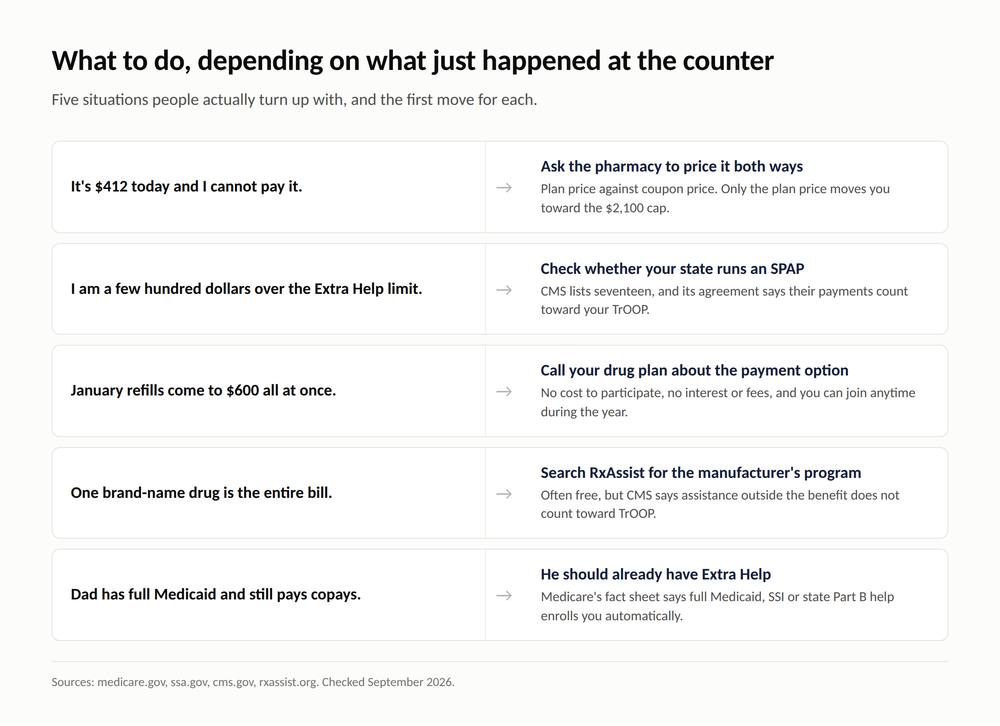
What to do, depending on what just happened at the counter
Check the Savings Programs too, not just Extra Help. Medicare Savings Programs are separate, run by your state, and pay Medicare premiums and cost sharing. Medicare.gov’s 2026 QMB limits are $1,350 monthly income and $9,950 in resources for an individual, $1,824 and $14,910 for a couple; SLMB allows $1,616 monthly and QI $1,816. It counts twice: QMB enrollees “will also get Extra Help paying for your prescription drugs” and “will pay no more than $12.65 in 2026 for each drug covered.”
Questions to ask before you commit to any of these
- Does this payment count toward my $2,100? Ask your drug plan, per drug and per program.
- What is my actual annual drug spend? Under $615 you may never touch the deductible, and the cap logic does not apply.
- Is the fund open right now? Foundation funds open and close with their funding, and an application to a closed one is wasted weeks.
- What happens at renewal? Most of these require re-application yearly. Ask the date now, not in December.
- If I pay someone to do this, what do I owe if my coverage does not fit? Get that in writing before the first appointment.
Where to start this week
Two calls, both free. First, Social Security on 1-800-772-1213 to start the Extra Help application, or do it online at ssa.gov. Even if you are sure you earn too much, the resource test excludes your house and your cars, which moves more people under the line than expect to be. Second, your State Health Insurance Assistance Program, funded by the Administration for Community Living, for counseling from what shiphelp.org calls “a trusted, unbiased source.” A counselor there will know whether your state has an SPAP.
Then decide one thing about this year: will you reach $2,100 in covered drug costs? If yes, run everything through the plan and chase the programs whose payments count. If no, the coupon is fine and the cap is a distraction. If you cannot tell, that is the question for a counselor or an advocate.
All figures were read in September 2026 on medicare.gov, ssa.gov, cms.gov, shiphelp.org, health.ny.gov and each organization’s own site. Income limits, cost-sharing amounts and fund availability change yearly and sometimes mid-year. Confirm with the agency before you rely on them.