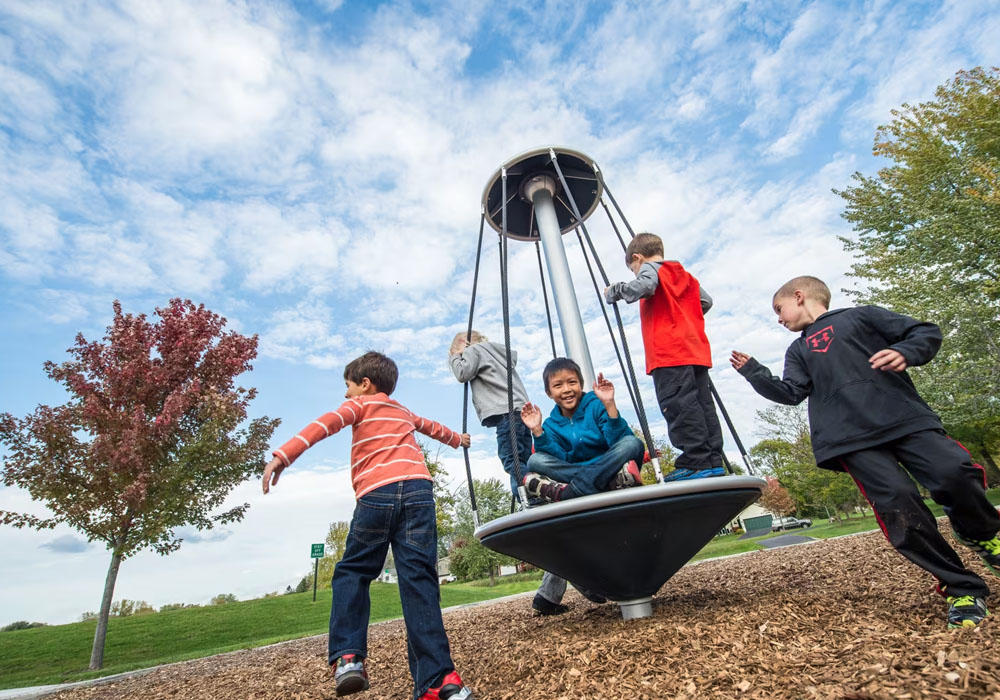
Watch a group of kids on a spinning piece of playground equipment and you’ll notice something. Nobody has to be told how to use it.
They figure out turns, pushing, holding on, and laughing at the dizzy wobble almost instantly, without any adult explaining the rules.
A playground spinner works on a part of child development that most other equipment barely touches, the vestibular system. That’s the sense responsible for balance, and it needs regular, varied movement to develop properly.
| Skill Area | How Spinning Equipment Helps |
| Vestibular processing | Rotational movement directly stimulates the inner ear balance system |
| Core strength | Holding steady during spin engages abdominal and back muscles |
| Social negotiation | Multi-user spinners require turn-taking and shared pushing |
| Sensory regulation | Rhythmic motion can calm sensory-seeking children |
What the Vestibular System Actually Does
Most people never think about their vestibular system until it goes wrong, like on a rocky boat. For kids, this system is still under construction, and it needs the right kind of input to mature properly.
Spinning, rocking, and rotational movement give the brain exactly that input. Occupational therapists have used spinning equipment for decades as a tool for children with sensory processing differences, and mainstream playground design has slowly caught up to the same idea.
Balance, Coordination and the Research Behind Rotational Play
Studies observing playground use, including children with developmental delays, found that activities involving rotation and hanging frequently support balance, coordination and agility. These are described as foundational skills for lifelong physical fitness, not just childhood fun.
What makes spinning equipment distinct from swings or slides is the multidirectional nature of the movement. A swing moves mostly front to back. A spinner adds rotation, which challenges a different part of the balance system entirely and complements what other equipment already trains.
Why Spinners Are Naturally Social
A slide is mostly a solo activity. A spinner rarely is. Most designs need at least one other child pushing, holding, or timing a jump onto a moving platform, which quietly builds cooperation without anyone framing it as a lesson.
Kids negotiate speed, whose turn is next, and how hard is too hard to push, all inside a two-minute burst of play. That kind of peer negotiation, done over and over across a school term, adds up to real social skill practice.
What to Check Before Choosing a Playground Spinner
- Weight capacity and the number of children it’s rated to hold safely at once.
- Ground clearance and impact-absorbing surfacing underneath, since falls do happen during spinning play.
- Age range suitability, as some spinners suit toddlers while others are built for a faster, older-kid pace.
- Bearing quality and maintenance needs, since a stiff or sticky spinner gets ignored fast.
- Accessibility features, so children using mobility aids aren’t left out of rotational play entirely.
Fitting a Spinner Into a Wider Play Space
A spinner works best as one piece in a varied playground, not the whole plan. Pairing rotational equipment with climbing structures and quieter sensory zones covers far more developmental ground than any single piece could alone.
Schools and parks that mix movement types tend to see steadier use across the whole space, since different children gravitate to different kinds of challenge on any given day. A spinner earns its spot by doing something the rest of the yard genuinely can’t.